AB-731 Isn’t Really About Certification — It’s Microsoft’s Warning About The Future Of AI Careers
For decades, Microsoft certifications measured whether professionals could build, deploy, or manage technology.
AB-731 measures something different.
It measures whether someone can make effective AI decisions.

This shift matters because the challenge in enterprise AI is no longer the tools themselves—it’s knowing where, how, and when to apply them. Organizations have access to powerful AI, but the ability to decide intelligently is now the limiting factor.
The Real Problem Enterprise AI Is Facing In 2026
The AI landscape in 2026 is saturated with technology. Most enterprises already have access to Copilot, ChatGPT, Claude, AI search platforms, and a range of automation tools. Yet, despite this unprecedented availability, many AI initiatives stall or fail outright. The reason is not technical limitation; it is what I call “The AI Decision Gap.”
The AI Decision Gap represents the disconnect between AI capability and AI execution. Organizations can technically implement AI solutions, but determining where AI belongs, where it doesn’t, what should be automated, and what must remain human-led has become increasingly complex. The stakes are high. Decisions made in this gap influence ROI, productivity, risk exposure, and long-term organizational culture.
Consider a global insurance firm that deployed AI-based claims automation. The technology functioned flawlessly, but adoption lagged because regional managers were not aligned, workflows were inconsistent, and expectations were mismanaged. This is the essence of the AI Decision Gap: having tools is not the same as deriving value from them.
AB-731, intentionally or not, signals that Microsoft recognizes this problem. The certification is less about what you know and more about how you decide, emphasizing judgment over execution.
Why Technical AI Projects Fail Even When The Technology Works
Technical success and business success are rarely synonymous. AI projects often fail because organizations underestimate the organizational complexity involved in adoption. Common failure points include:
- Poor executive alignment – When leaders disagree on priorities, AI initiatives become fragmented.
- Unclear ROI – Without measurable outcomes, even effective AI systems are perceived as failures.
- Weak adoption – Employees resist change when the benefits are not apparent or processes are disrupted.
- Governance problems – Risk and compliance frameworks lag behind implementation.
- Unrealistic expectations – Leadership expects AI to solve problems instantly rather than as part of an iterative process.
Take a retail chain implementing AI-driven demand forecasting. The algorithm improved accuracy by 30%, but the merchandising teams continued using legacy processes due to workflow inertia. The project was technically successful but failed to deliver tangible business impact.
These examples underscore that decision-making, communication, and governance are as critical as technical capability. AB-731 appears designed to evaluate exactly these skills, preparing leaders to navigate the organizational realities of AI adoption.
AB-731 Reveals A Major Shift In Microsoft’s View Of Talent
Historically, Microsoft certifications validated execution. Azure administrators, security engineers, and infrastructure specialists were measured by their ability to deploy, configure, and maintain technology. AB-731 signals a dramatic shift: Microsoft is now validating decision-making as a professional skill.
| Previous Generation | Goal | Emerging Generation | Goal |
|---|---|---|---|
| Azure Administrators | Execute technology | AI Transformation Leaders | Decide where technology should be applied |
| Security Engineers | Implement controls | AI Strategy Advisors | Prioritize investments, manage risk |
| Infrastructure Specialists | Maintain systems | AI Program Managers | Align stakeholders and governance frameworks |
The emphasis moves from technical execution to strategic judgment. Microsoft appears to recognize that the AI era is less about building models and more about orchestrating value creation across complex enterprise systems. AB-731 codifies a professional identity that blends technological literacy with executive decision-making—a hybrid skillset increasingly in demand.
The New AI Career Ladder Nobody Is Talking About
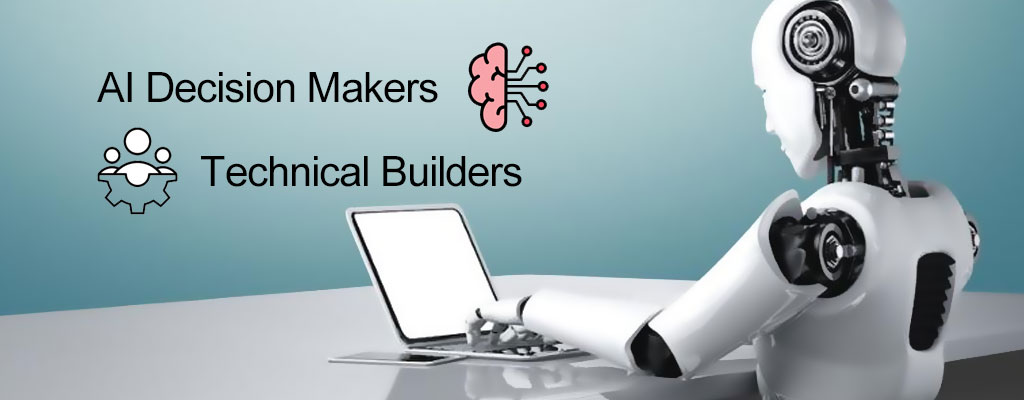
AI careers are diverging into two distinct tracks:
Track 1: Technical Builders
AI engineers, data scientists, and developers who create and maintain models, build infrastructure, and integrate solutions.
Track 2: AI Decision Makers
Leaders, strategists, program managers, and consultants who decide which AI initiatives to fund, oversee adoption, evaluate risks, and align AI with business strategy.
While both tracks are valuable, organizations increasingly struggle to fill the second. AI builders are abundant because universities, bootcamps, and online courses train them effectively. Decision-makers with deep understanding of both AI technology and enterprise strategy are rare.
Consider a multinational bank evaluating AI for fraud detection. Engineers can build predictive models, but only decision-makers can determine where to deploy them, how to balance false positives with operational cost, and which business units to involve. The scarcity of this second track is the hidden bottleneck in enterprise AI adoption.
The Hidden Skill AB-731 Is Actually Testing
AB-731 is not a test of memorization, product knowledge, or implementation skills. It measures the judgment required to make high-stakes AI decisions. Key competencies include:
- Prioritization – Identifying which AI initiatives deliver the most business value.
- Judgment – Choosing between competing investments with incomplete data.
- Trade-off analysis – Weighing cost, risk, and organizational impact.
- Business alignment – Ensuring AI supports strategic goals.
- Governance thinking – Anticipating regulatory, ethical, and reputational risks.
In practice, these skills manifest as decision frameworks within organizations. A healthcare provider deciding which patient workflows to automate with AI must balance compliance, patient safety, and clinician workload. AB-731 seems designed to measure whether a professional can navigate these scenarios effectively, rather than merely understand technical details.
Why Responsible AI Is Becoming A Leadership Issue
Responsible AI is no longer a technical checkbox. It has migrated to the C-suite because business consequences are now unavoidable. CEOs, boards, legal teams, and risk managers are increasingly involved in decisions regarding AI deployment.
Examples include:
- A global retail chain evaluating AI-driven pricing models must consider reputational risk if the algorithm is perceived as discriminatory.
- Financial institutions deploying AI credit scoring need executive oversight to ensure compliance with regulators and ethical guidelines.
Boards are no longer satisfied with assurances that “the technology is safe.” They demand proof that AI decisions are aligned with organizational strategy, risk appetite, and public trust. AB-731 implicitly reinforces this reality, emphasizing governance and accountability as core leadership skills.
Who Should Seriously Consider AB-731
The certification is relevant for professionals whose responsibilities intersect technology, strategy, and organizational leadership:
Good fit:
- AI consultants
- Technology managers
- Enterprise architects
- Digital transformation leaders
- Program managers
Less relevant:
- Developers
- Machine learning engineers
- Data scientists focused on implementation
The distinction is practical: AB-731 evaluates decision-making in AI adoption rather than technical depth. Attempting it without a role that engages in organizational AI strategy may offer limited value.
How To Prepare For AB-731 Without Thinking Like A Test Taker
Many candidates treat AB-731 like a technical exam and fail to recognize the scenario-oriented nature of the assessment. Preparation should focus on:
- Scenario-based thinking
- Business evaluation frameworks
- Organizational trade-offs
- Governance and ethical decision-making
Some candidates supplement Microsoft’s official learning paths with scenario-driven study materials to better understand how enterprise AI decisions are evaluated. Resources such as https://www.leads4pass.com/ab-731.html offer examples of scenario-based exercises. The goal is judgment development, not memorization.
What AB-731 Predicts About The Future Of Enterprise Hiring
AB-731 hints at a larger workforce trend: organizations may increasingly value professionals who can:
- Evaluate AI opportunities
- Manage risk
- Justify investments
- Drive adoption
Technical skills remain critical, but the real differentiator in AI success may be strategic judgment. Organizations that fail to cultivate and hire this capability risk deploying technology without achieving measurable business outcomes. AB-731 offers a framework for recognizing and validating these professionals, suggesting a future in which AI decision-makers are as critical as AI builders.
Conclusion
The next shortage in enterprise AI may not be engineers. It may be leaders capable of deciding which AI initiatives deserve attention, resources, and adoption support.
AB-731 is more than a certification; it is Microsoft’s signal about the evolving nature of AI talent. The companies that thrive in the AI era will not be those with the most advanced models—they will be those with the clearest judgment.
And that distinction will define the future of AI careers.
Author