AI-901 Exam: What You Need to Learn – and What You Don’t
Preparing for AI-901 is not difficult because artificial intelligence is complicated. The real challenge is knowing which concepts deserve your attention — and which topics create unnecessary study time.
AI-901 Is Not an AI-900 Replacement. It Reflects a Different Expectation
The first question I usually hear about Microsoft AI-901 is straightforward:
“Is this just AI-900 with updated content?”
It is an understandable question.
AI-900 introduced a generation of learners to Azure AI concepts. It became a common starting point for professionals who wanted to understand artificial intelligence without becoming machine learning specialists.
AI-901 continues that foundation, but the preparation mindset needs to change.
The difference is not simply a new list of technologies.
The bigger change is the type of thinking Microsoft expects from candidates.
AI-900 preparation often focused on recognizing AI concepts:
- What is machine learning?
- What is computer vision?
- What is natural language processing?
- What are responsible AI principles?
Those concepts remain relevant.
However, AI-901 preparation requires a stronger connection between technology and business decisions.
The question is moving from:
“What does this AI technology mean?”
toward:
“Which Azure AI capability solves this problem?”
That distinction explains why some learners with strong technical backgrounds still find fundamentals exams challenging. They understand technology, but they approach the exam as a terminology review instead of a scenario-based decision exercise.
AI-900 vs AI-901: The Difference Is About Application
| Area | AI-900 | AI-901 |
|---|---|---|
| Primary goal | Introduce AI concepts | Understand Azure AI solution scenarios |
| Learning approach | Recognize terminology | Connect requirements with capabilities |
| Machine learning | Basic concepts | Practical use cases and evaluation understanding |
| Computer vision | Service awareness | Selecting the right vision approach |
| Language AI | Understanding NLP concepts | Matching language problems with solutions |
| Generative AI | Limited coverage | Greater relevance in modern AI workflows |
| Preparation focus | Learn the landscape | Make informed technology choices |
The mistake is treating AI-901 as a vocabulary exam.
Knowing that OCR extracts text from images is useful.
Knowing when OCR is the appropriate solution is what creates exam readiness.
The Real AI-901 Preparation Problem: Too Much Content, Not Enough Prioritization
The internet has created an unusual problem for certification learners.
Finding information is easy.
Deciding what deserves attention is harder.
An AI-901 study plan can quickly expand into:
- multiple video courses
- bookmarked articles
- old AI-900 notes
- practice question collections
- unrelated AI tutorials
The activity feels productive because progress is visible.
More tabs are open.
More notes are created.
More resources are saved.
But preparation quality does not improve automatically with resource volume.
The stronger approach is identifying the concepts that influence decision-making.
For AI-901, those areas usually include:
- selecting appropriate Azure AI services
- understanding AI workload categories
- recognizing machine learning scenarios
- connecting business requirements with technical solutions
- understanding responsible AI considerations
A candidate who understands these relationships often has a clearer advantage than someone who has collected extensive notes without understanding how concepts connect.
Azure AI Fundamentals: Learn Services Through Problems, Not Definitions
Azure AI services are easier to understand when viewed from the problem being solved.
A common preparation pattern is creating lists:
Computer Vision → images
Language Service → text
Machine Learning → predictions
The information is accurate.
The problem is that exam questions rarely appear as isolated definitions.
They appear as situations.
Consider the difference.
A definition-based question:
“Which technology analyzes images?”
A scenario-based question:
“A company wants to identify defective products on a manufacturing line using camera images. Which AI capability should be considered?”
The second question requires understanding the purpose behind the technology.
Computer Vision: The Output Determines the Solution
Computer vision is a good example of where memorization creates confusion.
Several capabilities can involve images, but they solve different problems.
Image Classification
Used when the goal is assigning a category.
Example:
A company wants to classify incoming product images as:
- acceptable
- damaged
- incorrect packaging
The system needs a label.
Object Detection
Used when location matters.
Example:
A warehouse wants to identify and locate packages inside camera footage.
The system needs to know:
- what objects exist
- where they appear
OCR
Used when the requirement involves extracting text.
Example:
A company wants to process scanned documents and convert printed information into usable data.
The preparation lesson is simple:
Do not memorize computer vision features separately.
Understand the business question first.
Machine Learning: Understand the Role, Not the Mathematics
Machine learning creates unnecessary anxiety during AI-901 preparation.
The reason is understandable.
The field includes advanced mathematics, statistics, and complex algorithms.
Those topics are valuable for specialists.
They are not the center of an Azure AI fundamentals certification.
AI-901 does not require candidates to design new algorithms.
It requires enough understanding to recognize how machine learning supports solutions.
The concepts worth focusing on include:
- supervised learning
- classification
- regression
- training data
- evaluation concepts
- model performance
The practical question is:
“What type of prediction problem exists?”
For example:
A business wants to predict future sales.
That is different from:
A business wants to identify fraudulent transactions.
Both involve machine learning, but the problem type influences the solution approach.
The Evaluation Question Matters
Understanding model evaluation is often more useful than studying algorithm details.
A model can produce predictions.
The next question is:
“Can those predictions be trusted?”
That introduces concepts such as:
- accuracy
- reliability
- limitations
- evaluation results
The certification perspective is not about becoming a data scientist.
It is about understanding why a model may or may not be suitable for a particular scenario.
Natural Language Processing: Focus on What the Business Needs to Understand
Language AI can appear broad because human communication itself is broad.
For AI-901 preparation, the practical approach is identifying the purpose.
A company may want to:
- understand customer sentiment
- extract information from documents
- identify important terms
- interpret user requests
Each requirement points toward a different capability.
Sentiment Analysis
The goal is understanding emotional direction.
Example:
A company analyzes thousands of customer comments to identify satisfaction trends.
Entity Recognition
The goal is identifying meaningful information.
Examples:
- names
- locations
- organizations
- products
Language Understanding
The goal is interpreting user intent.
Example:
A support application needs to distinguish between:
- billing questions
- technical problems
- account requests
The important preparation skill is connecting the language problem with the appropriate Azure AI approach.
Why Microsoft Foundry Matters for AI-901 Preparation
AI discussions changed significantly with the growth of generative AI.
The conversation is no longer limited to prediction models and classification.
Organizations now explore questions such as:
- How can employees interact with internal knowledge?
- How can applications generate useful responses?
- How should AI outputs be evaluated?
- How can AI be used responsibly?
This is why understanding Microsoft Foundry concepts becomes increasingly relevant.
The goal is not memorizing every feature.
The goal is understanding the workflow:
- Identify the business requirement.
- Choose an appropriate AI capability.
- Work with models and services.
- Evaluate results.
- Consider responsible AI principles.
This approach matches how organizations think about AI adoption.
Topics That Receive Too Much Attention During AI-901 Preparation
A good preparation strategy requires knowing where to stop.
Some topics are interesting but provide limited value for this certification.
Advanced Mathematics
Understanding why models work is valuable.
Learning every mathematical foundation behind machine learning is a different goal.
For AI-901, focus on:
- what evaluation means
- why data quality matters
- how models are used
Do not allow mathematical theory to replace broader exam preparation.
Deep Learning Architecture
Modern AI discussions often mention:
- neural networks
- transformers
- model training
- large language models
These concepts explain important developments.
However, AI-901 is not testing whether you can design a deep learning architecture.
The relevant question is:
“Do you understand where these technologies fit?”
Complex Programming
Programming knowledge helps.
Advanced software engineering skills are not the requirement.
The exam does not expect you to build a production AI application from scratch.
A basic understanding of:
- SDK examples
- API interactions
- service communication
is generally more aligned with the certification level.
The Python Question: What AI-901 Really Requires
Python appears frequently in AI learning resources, which creates confusion.
Candidates sometimes assume programming experience is mandatory.
It is not.
The useful level of Python knowledge is understanding examples:
- importing a library
- connecting to a service
- sending information
- receiving results
The goal is understanding interaction with AI services.
The goal is not becoming a Python developer.
A Practical AI-901 Preparation Strategy
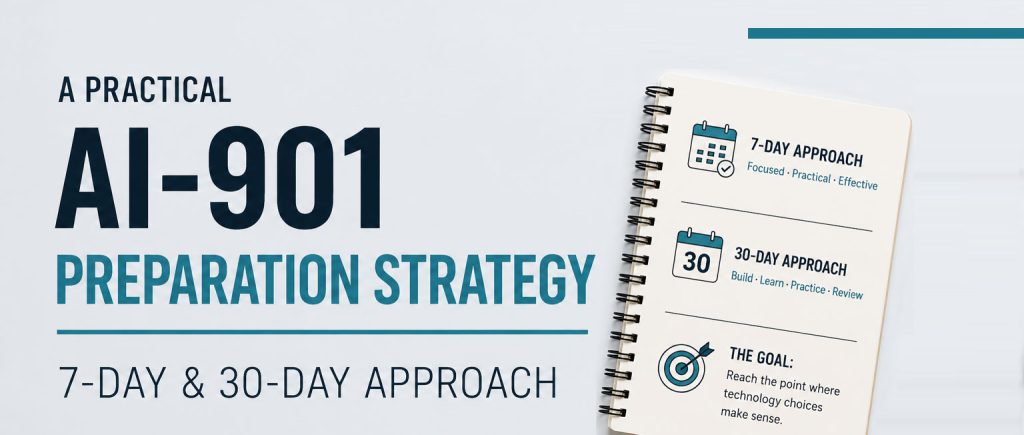
Seven-Day Approach
For learners already familiar with Azure:
Days 1–2
Review:
- exam objectives
- Azure AI categories
- responsible AI principles
Days 3–4
Focus on:
- computer vision
- language AI
- machine learning scenarios
Day 5
Explore:
- Microsoft Foundry concepts
- generative AI workflows
Day 6
Practice:
- scenario questions
- weak areas
Day 7
Review:
- service selection decisions
- common mistakes
Thirty-Day Approach
For beginners:
Week 1
Build AI and Azure foundations.
Week 2
Study workload scenarios.
Week 3
Explore hands-on examples.
Week 4
Practice decision-making and review weak topics.
The objective is not creating the largest study notebook.
The objective is reaching the point where technology choices make sense.
AI-901 Preparation Mistakes That Waste Time
Using AI-900 Materials Without Reviewing Changes
Previous knowledge is useful.
The mistake is assuming older preparation materials represent the entire current exam environment.
AI changes quickly.
Always verify whether learning materials reflect current Microsoft guidance.
Memorizing Services Without Understanding Scenarios
Service names alone do not create confidence.
The better question:
“What problem does this capability solve?”
Ignoring Hands-On Exposure
A fundamentals exam does not require advanced development.
However, seeing Azure AI services in practice improves understanding.
Even small experiments can clarify:
- inputs
- outputs
- limitations
- workflows
Collecting Too Many Resources
A focused resource list usually produces better results.
Microsoft Learn, official documentation, practical exploration, and targeted practice are enough for many preparation paths.
Some candidates also use third-party practice resources to evaluate readiness before exam day. These resources work best as a supplement while Microsoft’s official materials remain the foundation.
Is AI-901 Worth Taking in 2026?
AI-901 is valuable when used for the right purpose.
It can help:
- Azure beginners understand AI workloads
- cloud professionals expand their technical range
- developers build AI awareness before deeper specialization
It should not be viewed as proof of advanced AI engineering ability.
For professionals targeting implementation roles, certifications such as AI-102, along with practical experience, represent a deeper path.
For cloud-focused professionals, combining AI knowledge with certifications such as AZ-900 or AZ-104 can create a broader Azure skill profile.
Final Perspective
The strongest AI-901 preparation strategy is not learning more information.
It is learning the right information in the right order.
The exam rewards candidates who understand the relationship between:
- business requirements
- AI capabilities
- Azure services
- responsible implementation
The question that improves preparation is not:
“How much AI theory can I study?”
It is:
“Can I explain why this Azure AI solution fits this situation?”
That is the skill Microsoft is trying to measure.
And that is where your preparation time creates the most value.
Author