
AB-730 AI Business Professional: Study Guide and Exam Tips
AB-730 is not an AI engineering exam. It is a test of whether professionals can turn Microsoft AI tools into practical workplace outcomes. The real question is not “Can you pass AB-730?” but “Does this certification represent the AI skills your career actually needs?”
What Is Microsoft AB-730 AI Business Professional?
There is a common assumption that every AI certification should move professionals closer to technical AI development. That assumption makes sense because early AI certifications were often connected to machine learning, data science, or cloud architecture.
AB-730 challenges that idea.
Microsoft created the AI Business Professional certification for a different category of professional: someone who uses AI as part of everyday decision-making, communication, research, and productivity. According to Microsoft’s official certification description, AB-730 focuses on generative AI productivity tools such as Microsoft 365 Copilot, Researcher, and Analyst, with no requirement to build AI applications or write code.
That positioning matters because workplace AI adoption has created a new skills gap. Organizations do not only need engineers who understand models and APIs. They also need employees who understand how to ask better questions, evaluate AI responses, protect sensitive information, and integrate AI into existing workflows.
The mistake many candidates make is assuming AB-730 is a “simpler AI exam.” That interpretation misses the point. The complexity is not in programming. The complexity is understanding how AI changes human decision processes.
A marketing manager using Copilot to analyze customer feedback faces different challenges from a developer creating an AI application. The manager needs to know whether the generated summary is reliable, whether confidential information is exposed, and whether the final business decision still requires human judgment.
This is where AB-730 fits.
Looking at Microsoft’s certification direction, the company appears to be separating AI skills into different professional responsibilities. Technical professionals need development and cloud-focused credentials. Business users need practical AI usage skills. Leaders need adoption and governance knowledge.
AB-730 belongs to the second category.
Why Microsoft Created a Business-Focused AI Certification
The assumption behind many traditional certifications is that valuable technology skills are technical skills. A person who understands architecture, configuration, or development is considered closer to the technology.
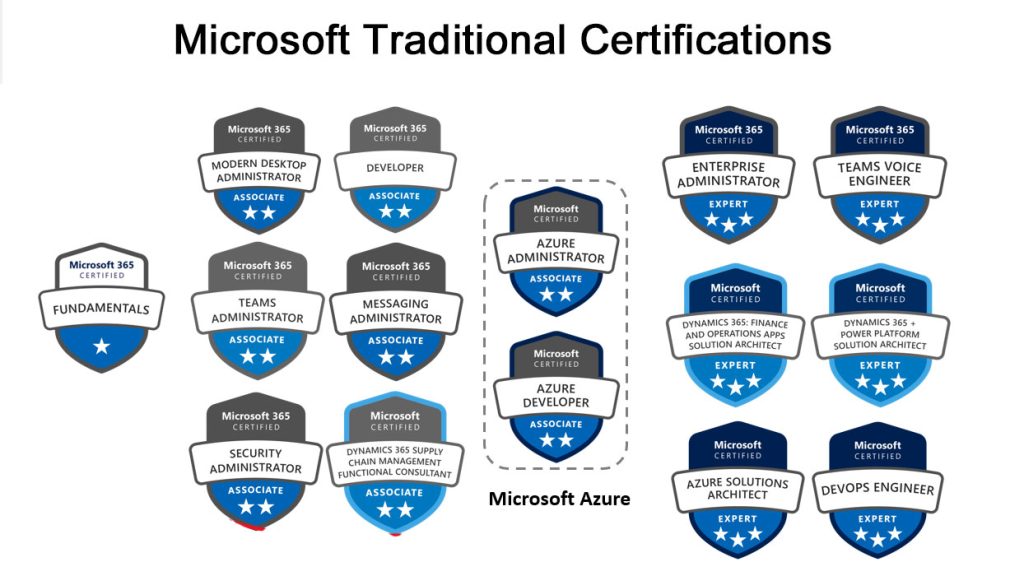
Generative AI changes that relationship.
A powerful AI assistant does not create value automatically. A poorly written prompt can produce unreliable output. A user who does not understand security boundaries can accidentally expose information. A manager who cannot evaluate AI-generated recommendations may simply automate bad decisions faster.
Microsoft’s decision to introduce AB-730 reflects a workplace reality: AI adoption depends heavily on users.
The certification focuses on areas such as:
- understanding generative AI concepts
- managing prompts and conversations
- creating and analyzing business content with AI
Microsoft’s current exam skills outline places significant weight on prompt interaction and business content creation, showing that practical AI usage is central to the exam.
Experienced professionals often disagree about business AI certifications. Some believe tool-based certifications become outdated quickly because AI products change rapidly. Others argue that foundational workflow skills remain valuable even as specific interfaces evolve.
Both perspectives contain truth.
A certification focused only on button locations inside a specific product may age poorly. A certification focused on principles such as prompt design, responsible AI usage, and business workflow improvement has a longer lifespan.
AB-730’s long-term value depends on whether candidates treat it as a product tutorial or as evidence of AI decision-making ability.
The stronger interpretation is the second one.
Who Should Consider Taking AB-730?
The easiest way to misunderstand AB-730 is to ask, “Who wants to learn AI?”
That question is too broad.
A better question is:
“Who needs to make better decisions with AI tools inside their existing role?”
That difference changes the target audience completely.
Business Professionals Using Microsoft 365
For analysts, operations specialists, project managers, marketers, HR professionals, and knowledge workers, AB-730 may align naturally with daily responsibilities.
Consider a project manager preparing a weekly executive update.
Without AI, the workflow might involve:
- collecting meeting notes
- reviewing documents
- summarizing decisions
- writing communication drafts
With Microsoft 365 Copilot, the workflow changes. The professional still owns the decision, but AI assists with preparation and analysis.
The certification does not prove that someone can replace a business process with automation. It demonstrates awareness of how AI can support that process.
That distinction matters.
Organizations rarely fail AI projects because employees cannot click an AI feature. They fail because employees do not know where AI fits, when human review is necessary, or how to measure useful outcomes.
AB-730 candidates should think beyond features.
The exam is less about remembering what Copilot can do and more about understanding why a certain AI approach makes sense in a workplace scenario.
IT Professionals Expanding Into AI Adoption
IT professionals sometimes assume they should immediately pursue developer-oriented AI certifications.
That may not always be the best first move.
An infrastructure administrator or Microsoft 365 administrator involved in Copilot deployment may benefit from understanding user-side AI adoption before moving into deeper technical areas.
Why?
Because successful AI implementation happens between technology and people.
An administrator may understand permissions, licensing, and configuration. But if employees do not understand responsible AI usage, the organization still struggles.
AB-730 can act as a bridge between traditional IT knowledge and modern AI adoption responsibilities.
However, it should not replace technical learning.
Someone pursuing AI solution architecture, Azure AI development, or machine learning engineering should consider more technical certification paths.
Who Should Probably Choose Another Certification?
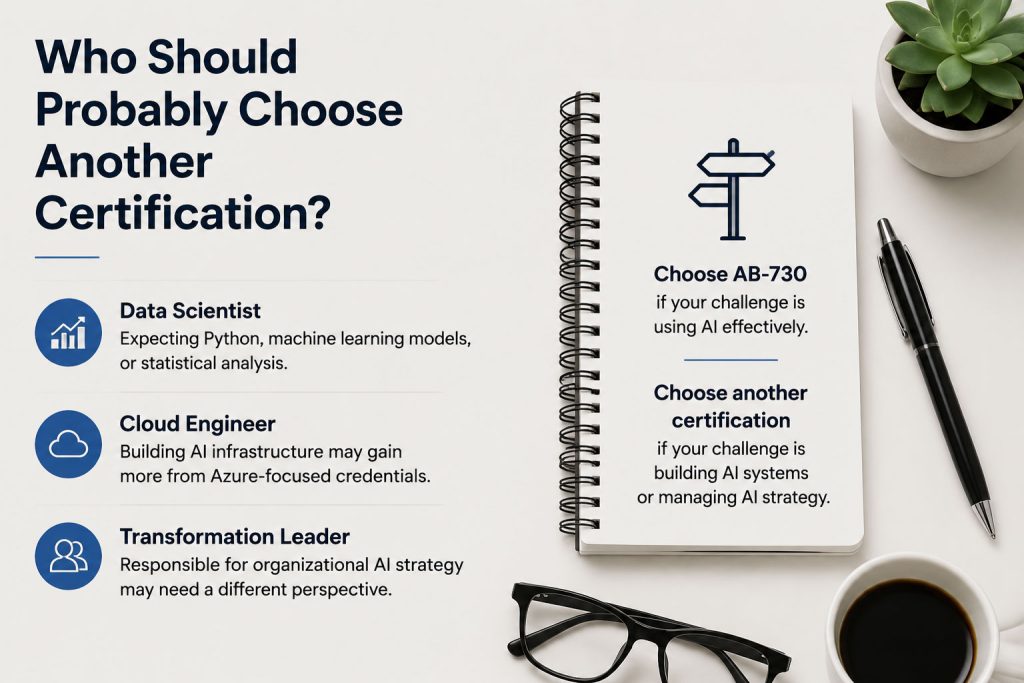
AB-730 is not designed for everyone.
A data scientist expecting Python, machine learning models, or statistical analysis will probably find the exam too business-focused.
A cloud engineer building AI infrastructure may gain more from Azure-focused credentials.
A transformation leader responsible for organizational AI strategy may need a different perspective.
Microsoft’s growing AI certification ecosystem reflects different roles rather than one universal AI path.
The practical decision is simple:
Choose AB-730 if your challenge is using AI effectively.
Choose another certification if your challenge is building AI systems or managing AI strategy.
AB-730 vs AI-901 vs AB-731 vs AZ-900: Which Certification Fits Your Goal?
Certification names create confusion because they sound similar while targeting different professional problems.
| Certification | Primary Focus | Best For |
|---|---|---|
| AB-730 | AI productivity and business usage | Business professionals using AI tools |
| AB-731 | AI adoption strategy and organizational implementation | Leaders managing AI transformation |
| AI-901 | AI fundamentals and concepts | Beginners learning AI foundations |
| AZ-900 | Azure cloud fundamentals | Professionals starting cloud learning |
The mistake is selecting certifications based only on difficulty.
A beginner may think the easiest exam is the correct starting point. A manager may think the highest-level certification provides the most career value.
Neither assumption is reliable.
The correct choice depends on the gap you are trying to fill.
A sales manager who needs to understand Copilot workflows may receive more practical value from AB-730 than a technical AI certification.
A technology leader planning enterprise AI adoption may find AB-731 more relevant.
Someone completely new to AI concepts may prefer AI-901 first.
Someone entering cloud technology may begin with AZ-900.
Certification planning is not about collecting badges. It is about building a coherent professional story.
What Skills Does AB-730 Actually Validate?
A common misunderstanding is that AB-730 tests whether someone knows Microsoft Copilot features.
That is only part of the picture.
The deeper question is whether someone can work effectively with AI-assisted productivity.
Generative AI Fundamentals and Responsible AI
The exam includes generative AI concepts because users need a mental model of how AI behaves.
Without that foundation, people often make two opposite mistakes.
Some trust AI too much.
Others reject AI completely because they misunderstand its limitations.
Professional AI usage requires a middle position.
AI can accelerate research, drafting, summarization, and analysis. It can also produce incorrect information, misunderstand context, or require human review.
Responsible AI awareness is therefore not a theoretical topic. It affects daily decisions.
Prompt Management and Copilot Workflows
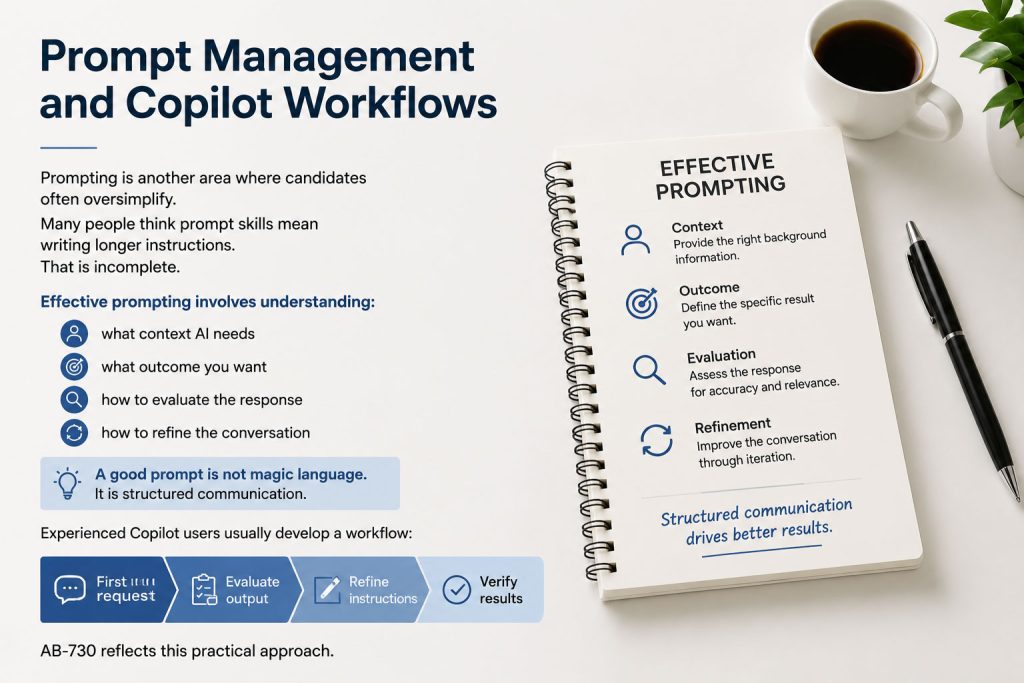
Prompting is another area where candidates often oversimplify.
Many people think prompt skills mean writing longer instructions.
That is incomplete.
Effective prompting involves understanding:
- what context AI needs
- what outcome you want
- how to evaluate the response
- how to refine the conversation
A good prompt is not magic language.
It is structured communication.
Experienced Copilot users usually develop a workflow:
First request → evaluate output → refine instructions → verify results.
AB-730 reflects this practical approach.
Is AB-730 Difficult?
Difficulty depends heavily on background.
For someone already using Microsoft 365 Copilot, AB-730 may feel familiar. For someone who has never worked with AI productivity tools, the learning curve can be larger.
Microsoft describes the exam audience as professionals comfortable with Microsoft 365 applications and generative AI productivity tools.
The challenge is not advanced mathematics or programming.
The challenge is scenario judgment.
Candidates must understand why one AI approach is better than another.
That requires experience.
Someone can memorize features and still struggle with scenario-based questions. Another person who regularly uses AI tools at work may understand the reasoning naturally.
How Long Should You Study for AB-730?
Preparation time depends on your starting point.
One Week Preparation
Suitable for:
- experienced Microsoft 365 users
- professionals already using Copilot
- candidates familiar with AI concepts
Focus on:
- exam objectives
- Microsoft terminology
- responsible AI principles
- Copilot scenarios
Two to Four Weeks Preparation
Better for:
- beginners
- professionals without Copilot access
- candidates transitioning into AI-related roles
A practical sequence:
- Learn generative AI fundamentals.
- Explore Microsoft 365 Copilot scenarios.
- Practice writing and refining prompts.
- Review business workflow examples.
- Test your understanding with practice questions.
Some candidates also use third-party practice resources such as Leads4Pass AB-730 practice resources to identify knowledge gaps before scheduling an exam. These resources should be treated as assessment tools rather than replacements for official learning.
Best Resources to Prepare for AB-730
The strongest starting point remains Microsoft Learn.
Microsoft provides the official AB-730 study guide, including skills measured and recommended preparation resources.
Useful preparation sources include:
- Microsoft Learn modules
- Microsoft 365 Copilot documentation
- Microsoft AI documentation
- Microsoft community discussions
Community discussions can also reveal practical exam experiences. Some candidates report that hands-on Copilot exposure helped them understand scenario questions better.
The important point is balance.
Official resources tell you what Microsoft measures.
Practical experience helps you understand why those skills matter.
You need both.
Final Decision Framework: Should You Take AB-730?
The wrong question is:
“Is AB-730 valuable?”
The better question is:
“What professional problem does AB-730 solve for me?”
Take AB-730 if:
- your work involves Microsoft 365
- you want structured AI productivity skills
- you need confidence using Copilot-style tools
- you want to demonstrate practical AI adoption knowledge
Consider another path if:
- you want to build AI applications
- you want deep Azure AI engineering skills
- you focus on enterprise AI governance
AB-730 fills a specific gap.
It validates the ability to work effectively with AI in business environments.
That skill is becoming increasingly relevant, but its value depends on how closely it matches your actual responsibilities.
Author

