Microsoft AB-100 Explained: What the Agentic AI Business Solutions Architect Exam Really Tests
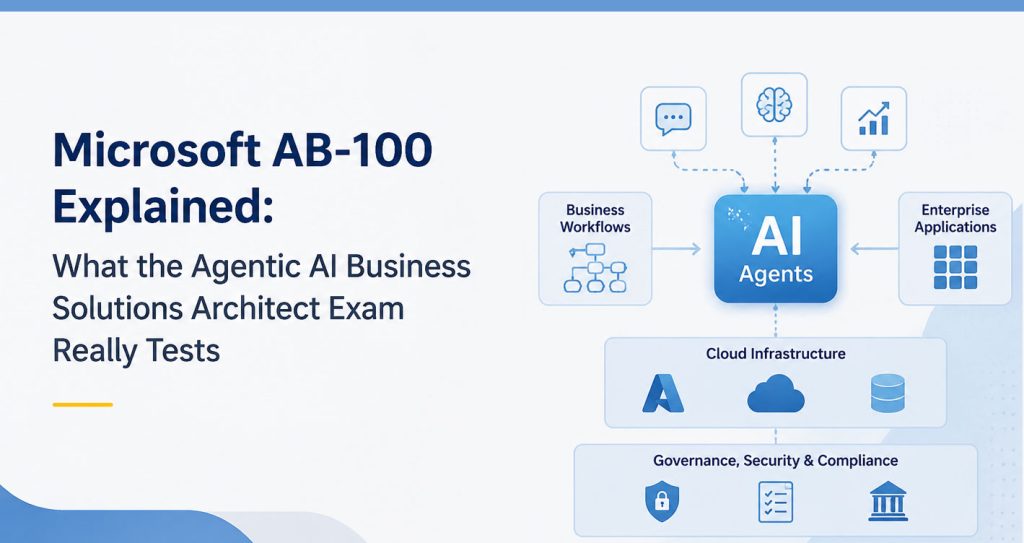
A company rarely fails with AI because it cannot build a chatbot. It fails because nobody can decide where AI belongs, how agents should operate, and how risk should be controlled. AB-100 reflects this new architectural challenge.
The AI Certification Landscape Is Changing
For years, cloud and AI certifications followed a predictable pattern. A professional learned a platform, understood its services, practiced implementation tasks, and proved they could configure technology correctly. That model worked when cloud adoption was mainly about infrastructure migration and when AI projects were mostly focused on building individual machine learning solutions.
Agentic AI changes the conversation. Organizations are no longer asking only, “Can we build an AI application?” They are asking harder questions: “Should this workflow be automated?”, “What data should the agent access?”, “How much independence should the AI receive?”, and “How do we measure whether the system creates business value without introducing unacceptable risk?”
This shift explains why Microsoft introduced the Agentic AI Business Solutions Architect certification and the associated AB-100 exam. The certification is designed for professionals who can plan, design, and govern AI-powered business solutions rather than simply implement individual AI components. Microsoft positions the certification around solution architects who create scalable, secure AI solutions using technologies such as Microsoft Copilot, Copilot Studio, and Microsoft AI Foundry.
When reviewing the direction of modern certification programs, one pattern becomes clear: AI architecture is becoming less about knowing every available model and more about making responsible decisions. A solution architect is not valuable because they can connect an AI model to an application. They are valuable because they understand when that connection creates business value, when it creates unnecessary complexity, and how to build guardrails around it.
This is also where AB-100 separates itself from earlier AI certifications. The exam reflects a market reality that enterprise companies are discovering: AI adoption is not primarily a technology problem. It is an architecture problem involving people, processes, security, data, cost, and governance.
Microsoft’s own AB-100 learning materials describe the certification as advanced-level preparation for architects, senior consultants, and technical leaders responsible for planning, designing, and governing AI-powered enterprise solutions.
Why Agentic AI Requires a Different Professional Mindset
Traditional AI applications often followed a simple pattern. A user provided input, an AI model processed that information, and the system returned an output. Agentic AI introduces another layer: AI systems can plan tasks, interact with tools, make decisions within boundaries, and coordinate multiple actions.
That creates architectural questions that did not exist at the same scale before.
Imagine a customer support agent connected to company systems. A basic AI assistant might answer questions from documentation. An agentic system could potentially check customer history, create service requests, recommend solutions, and trigger business processes.
The technical challenge is no longer just model selection.
The architect must consider:
- What permissions should the agent have?
- Which actions require human approval?
- How should sensitive customer data be protected?
- How should failures be detected?
- How should performance and cost be monitored?
These are architecture decisions.
That is why AB-100 represents a broader change in AI certification philosophy. It measures whether professionals can think through complete business solutions instead of isolated technical features.
AB-100 Is Not the AI Certification Many Candidates Expect
One of the first misunderstandings around Microsoft AB-100 comes from professionals approaching it with expectations shaped by developer-focused AI exams.
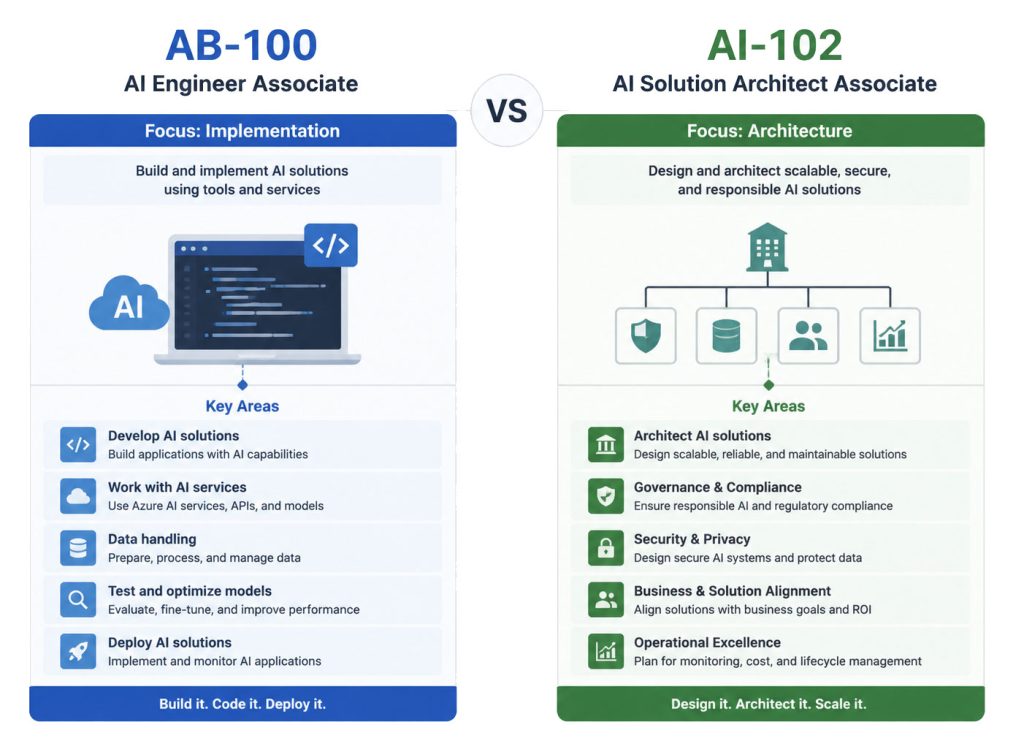
Candidates with experience in AI development often compare it with AI-102: Azure AI Engineer Associate. While both certifications involve artificial intelligence, they evaluate different capabilities.
| Area | AI-102 | AB-100 |
|---|---|---|
| Primary focus | Building AI solutions | Architecting AI business solutions |
| Typical role | AI engineer, developer | Solution architect, AI strategist |
| Main concern | Implementation | Business alignment and design decisions |
| Technical emphasis | Azure AI services, development patterns | Architecture, governance, agent strategy |
| Success measure | Can you build the solution? | Can you design the right solution? |
AI-102 remains valuable for professionals who create and deploy AI applications. AB-100 moves one level higher by asking whether those applications should exist in a particular form and how they should operate inside an organization.
Candidates entering from software development backgrounds often discover that knowing APIs, SDKs, and model integration is not enough. The exam requires a broader perspective.
A developer may naturally ask:
“How do I create this AI workflow?”
An architect asks:
“Does this workflow solve the correct business problem, and what constraints must exist before deployment?”
That difference changes the entire preparation approach.
A cloud architect who already understands networking, identity, security, and enterprise design patterns may find AB-100 concepts more familiar than a developer who has built AI applications but has limited exposure to organizational decision-making.
Professionals comparing cloud architecture paths may also explore concepts covered by certifications such as AWS Solutions Architect Associate, because the underlying discipline of designing scalable, secure, cost-aware cloud solutions remains highly transferable.
What AB-100 Really Tests Beyond Microsoft’s Exam Objectives
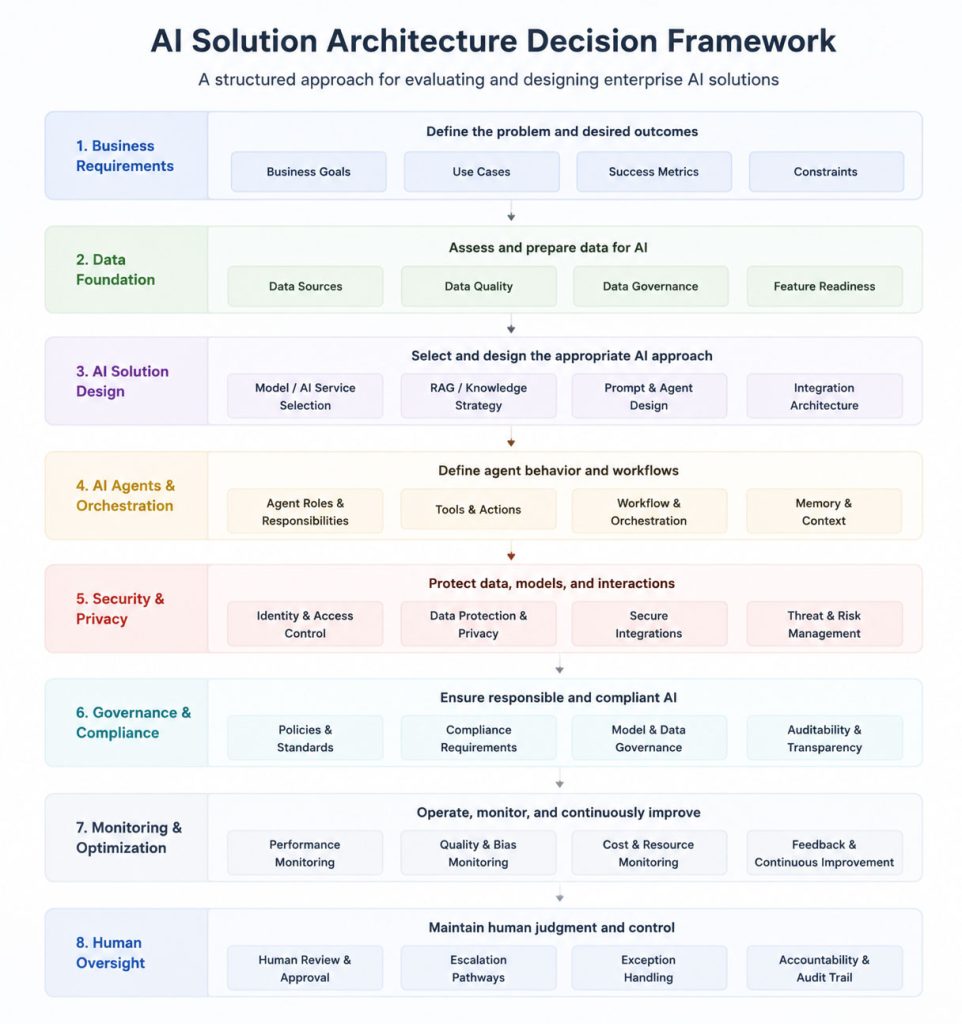
Microsoft divides AB-100 skills into three broad areas: planning AI-powered business solutions, designing AI-powered business solutions, and deploying AI-powered business solutions. The official study guide currently emphasizes these areas, with deployment and governance representing the largest portion of assessed skills.
However, understanding the exam requires looking beyond percentages.
Translating Business Problems Into AI Opportunities
The first architectural challenge is deciding whether AI is actually the right solution.
A company may approach an architect saying:
“We need an AI agent for customer service.”
That statement contains a technology preference, not a business requirement.
The architect must investigate:
- What customer problem exists?
- How frequently does it occur?
- What data supports the workflow?
- What decisions can safely be automated?
- Where must humans remain involved?
This is where many technically skilled professionals need to adjust their thinking.
AI architecture starts with business understanding.
A poorly designed AI solution can be technically impressive but operationally useless. A simple automation workflow may sometimes create more value than a complex multi-agent system.
AB-100 evaluates whether candidates understand this distinction.
Designing Enterprise AI Solution Architectures
The second challenge is choosing the correct architecture.
Enterprise AI rarely involves only one component. A production solution may combine:
- AI models
- business applications
- data sources
- identity systems
- monitoring tools
- security controls
- governance processes
Microsoft AI Foundry and Copilot Studio are examples of platforms designed to help organizations build and manage AI applications and agents. Copilot Studio guidance emphasizes planning, architecture, responsible AI practices, success criteria, and governance when creating agent solutions.
An AB-100 candidate needs to understand why one architecture pattern fits a business scenario better than another.
For example:
A financial organization may require strict approval workflows before an AI agent performs transactions.
A marketing department may allow more autonomous content generation.
A healthcare environment may require stronger controls around data access and auditing.
The architecture changes because the business context changes.
Making AI Systems Secure, Governed, and Operational
Deployment is where many experimental AI projects fail.
A prototype can work perfectly in a demonstration environment. Enterprise deployment introduces different requirements.
Organizations need:
- access control
- monitoring
- responsible AI reviews
- lifecycle management
- cost management
- security validation
The AB-100 exam reflects this reality by focusing heavily on deployment and governance decisions.
An AI agent is not simply another application. It can interact with information and systems in ways that create new operational risks.
The architect’s responsibility is creating a system that remains useful after it leaves the demonstration stage.
The Hardest Part of AB-100 Is Thinking Like an Architect
The biggest challenge for AB-100 candidates is usually not learning another Microsoft service. It is changing the way they evaluate problems.
A developer mindset focuses on construction.
An architect mindset focuses on decisions.
Both are valuable, but they solve different problems.
Consider a company creating an internal HR assistant.
A developer may focus on connecting the language model to employee documents.
An architect considers:
- Are employees allowed to access all documents?
- How will permissions be inherited?
- What happens when the AI provides incorrect information?
- How will sensitive employee data be protected?
- How will success be measured?
The difference is similar to building a house. A builder focuses on putting materials together correctly. An architect considers whether the design fits the environment, regulations, budget, and long-term needs.
AB-100 is testing the architect.
Enterprise AI Agent Decisions Require Trade-Offs
Real organizations rarely have perfect conditions.
A company may want the smartest AI model, but budget limitations exist.
A business team may want maximum automation, but compliance requirements limit autonomy.
Users may want instant answers, but security teams require verification.
Architecture is the process of balancing these competing requirements.
That is why AB-100 feels different from implementation exams. The correct answer is often not the most technically advanced option. It is the option that best matches business goals and organizational constraints.
What Early Candidates Are Struggling With
Early AB-100 discussions reveal several practical challenges for professionals preparing for this certification.
Finding Reliable Preparation Resources
Because AB-100 is a relatively new certification, preparation materials are still developing. Some candidates describe difficulty finding resources that go beyond basic exam outlines and explain the architectural reasoning behind the topics.
This creates a different learning experience compared with mature certifications that have years of books, courses, and practice exams.
The best preparation approach is not collecting question banks. It is building understanding from official architecture guidance, Microsoft Learn resources, and real solution design scenarios.
Candidates looking for additional exam preparation resources may evaluate structured AB-100 practice materials such as Leads4Pass, especially when they need scenario-based review before scheduling the exam.
Understanding Agent Orchestration Concepts
Professionals entering from traditional cloud backgrounds often understand infrastructure but need time to understand agent behavior.
Agentic AI introduces concepts such as:
- planning
- orchestration
- grounding
- tool usage
- multi-agent collaboration
The challenge is learning when these patterns are useful.
Not every problem requires multiple agents.
Sometimes a simpler workflow creates better reliability.
The architect must understand complexity before introducing it.
Connecting Microsoft Products With Business Scenarios
Azure professionals commonly discover that AB-100 requires familiarity with Microsoft business platforms, including Copilot Studio, Dynamics 365 concepts, and Power Platform integration patterns.
The challenge is not memorizing product names.
The challenge is understanding how technology supports business outcomes.
Who Should Consider Taking AB-100?
AB-100 is most suitable for professionals moving toward AI architecture responsibilities.
Good candidates include:
- AI solution architects
- Azure solution architects
- enterprise architects
- technical consultants
- digital transformation leaders
- experienced cloud professionals moving into AI strategy
These professionals already understand that technology decisions exist inside business environments.
For example, an Azure architect may already know how to design secure cloud workloads. AB-100 extends that thinking into AI systems where models, agents, and automation introduce additional considerations.
The certification may be less suitable for complete beginners.
Someone starting with AI may benefit first from foundational learning or implementation-focused certifications.
Likewise, developers who only want to write AI application code may find AB-100 less aligned with their immediate goals.
The certification is about becoming the person who decides how AI solutions should be designed.
A Practical AB-100 Preparation Approach
Preparing for AB-100 requires a different strategy from traditional exam preparation.
The goal should not be remembering product features.
The goal should be developing architectural judgment.
A practical framework looks like this:
| Learning Area | What to Understand |
|---|---|
| Business analysis | How organizations identify valuable AI opportunities |
| Architecture | How AI components work together in enterprise environments |
| Security | Identity, access control, and data protection decisions |
| Governance | Responsible AI, monitoring, and lifecycle management |
| Platforms | Copilot Studio, AI Foundry, and Microsoft ecosystem integration |
Start by studying business scenarios.
Ask questions such as:
“Why would an organization choose an AI agent here?”
“What risks appear if the agent receives more autonomy?”
“What architecture would scale beyond a prototype?”
Then study the Microsoft ecosystem.
Understand how AI solutions connect with existing enterprise platforms.
Finally, practice making decisions.
A strong AB-100 candidate should be comfortable explaining why one architecture is preferable to another.
AB-100 and the Future of AI Solution Architecture
AB-100 reflects a larger industry shift.
Organizations are moving beyond AI experiments and integrating AI into daily business operations. This change requires professionals who can connect technical solutions with business goals and responsibility.
Future AI architects will do more than select models. They will design systems where humans and AI agents work together, define boundaries, manage risks, and decide where automation creates value.
This is why AB-100 matters beyond certification. It represents a growing role: architects who understand AI as a business capability, not just a technical feature.
As enterprise AI adoption grows, professionals who can build secure, scalable, and responsible AI solutions will become increasingly valuable.
Conclusion
Microsoft AB-100 represents a new direction for AI professionals. It focuses on designing AI solutions that solve real business problems.
The certification is not only about AI tools or technical skills. It also tests how candidates make architecture choices, manage risks, and support responsible AI adoption.
AB-100 helps AI engineers move from building solutions to leading broader AI projects. It helps cloud architects understand enterprise AI strategy. It also helps consultants support organizations adopting AI agents.
The best preparation is not learning more platforms or services. It is learning how to decide where AI creates value, where humans need control, and how AI systems should operate safely.
Frequently Asked Questions About Microsoft AB-100
What is Microsoft AB-100?
Microsoft AB-100 is the exam associated with the Microsoft Certified: Agentic AI Business Solutions Architect certification. It focuses on designing, deploying, and governing AI-powered business solutions using Microsoft technologies.
Is AB-100 harder than AI-102?
The difficulty depends on your background. AI-102 is more implementation-focused, while AB-100 requires stronger architecture judgment, business understanding, and governance knowledge.
Should Azure architects take AB-100?
Azure architects who want to move into enterprise AI solution design may find AB-100 highly relevant because it extends cloud architecture skills into AI systems.
Does AB-100 require coding experience?
Coding knowledge can help, but the exam focuses more on architecture decisions than writing AI applications.
How should I prepare for the AB-100 exam?
Focus on AI architecture patterns, Microsoft AI platforms, governance concepts, security considerations, and realistic enterprise scenarios rather than memorizing isolated services.
Author