AI-500 Is Harder Than It Looks. Here’s What You Actually Need to Be Ready.

AI-500 is not the kind of Microsoft exam I would prepare for by reading every available document from beginning to end.
The exam is new, the technology changes quickly, and there are already a lot of terms to keep track of: multi-agent systems, Microsoft Foundry, RAG, MCP, memory, orchestration, evaluation, security, monitoring, and deployment.
For AI-500 exam preparation, the better approach is to understand the type of decision the question is asking you to make, identify the part of the system involved, and eliminate answers that solve the wrong problem.
Practice is also crucial. While official practice materials—which generally serve only to familiarize candidates with question formats and exam rules—may not yet be available, resources that clearly highlight the exam’s key focus areas are truly valuable. For instance, https://www.leads4pass.com/ai-500.html offers effective practice questions and a free online trial.
That is what this guide focuses on.
What Makes AI-500 Preparation Different?
AI-500 is aimed at experienced practitioners rather than beginners. Microsoft describes the target candidate as someone who can design, build, optimize, secure, and deploy production-ready multi-agent AI systems and workflows. The current exam is divided across architecture, development, evaluation and optimization, and security/governance/deployment.
That sounds broad, but you don’t need to memorize the entire Microsoft documentation library.
You need to be comfortable looking at a scenario and asking:
What is the problem here?
Is the question really about an agent?
Or is it about memory?
Is it actually testing orchestration?
Or is the important detail hidden in permissions, evaluation, deployment, or monitoring?
That distinction can save a lot of study time.
A candidate who treats every AI-500 question as an “AI agent question” can easily miss the actual requirement in the scenario.
Start With the Exam Topics, Not With Random Questions
Before working through practice questions, spend some time understanding the current AI-500 objectives.
Microsoft currently lists four major areas:
| Exam area | Weight |
| Architect multi-agent solutions | 15–20% |
| Develop multi-agent solutions in Azure | 30–35% |
| Evaluate, optimize, and monitor multi-agent solutions | 20–25% |
| Secure, govern, and deploy multi-agent solutions | 20–25% |
The development section has the largest weighting, but don’t make the mistake of spending almost all your time there.
The other sections can produce difficult scenario questions because they require you to connect several concepts.
For example, a question may describe an agent calling an external service. At first glance, that sounds like a tools question. But the correct answer may depend on identity, permissions, authentication, secrets, or guardrails.
The technology named in the question is not always the thing being tested.
That is one of the first habits I would develop.
Don’t Try to Memorize Every AI-500 Technology
You will probably encounter terms such as Microsoft Foundry, Microsoft Agent Framework, MCP, RAG, LangGraph, memory, orchestration, agent-to-agent communication, evaluation, tracing, guardrails, and observability while preparing.
You don’t need to turn every term into a separate study project.
Instead, connect each technology to the problem it solves.
For example:
RAG → How does the system obtain relevant external knowledge?
Memory → What information should the system retain and use later?
MCP → How can an agent interact with tools or external context through a standardized approach?
Orchestration → How should multiple tasks or agents coordinate?
Evaluation → How do you determine whether the system is producing acceptable results?
Observability → How do you understand what happened when the system behaves badly?
Once you think this way, the vocabulary becomes easier to manage.
You are no longer memorizing a collection of disconnected definitions.
You are building a mental map of an AI system.
AI-103 Knowledge Can Help With AI-500
If you have already prepared for AI-103, don’t throw that knowledge away.
There is a natural connection between the two exams.
AI-103 focuses on developing AI applications and agents on Azure, while AI-500 moves further into multi-agent architecture, production workflows, evaluation, security, and deployment.
The overlap is especially useful around agents, generative AI applications, tools, grounding, and Microsoft Foundry.
If you are preparing for both certifications, I would not study the same material twice.
Instead, use AI-103 as an application-development foundation and then extend that knowledge toward the architectural questions that AI-500 introduces.
Leads4Pass already maintains separate AI-103 preparation materials, including PDF and Web TestEngine formats, so candidates following both paths can keep their preparation resources organized by exam rather than mixing everything into one large study set.
If AI-103 is where you learn how to build an AI application or agent, AI-500 asks you to think harder about what happens when that system becomes larger, more autonomous, and more complicated.
That is a useful distinction to keep in mind.
A Sneak Peek at the AI-500 Exam Questions
Note:
1.This content is shared with authorization from Leads4Pass.
2.A total of 15 of the latest test questions are presented here—feel free to try your hand at solving them!
3.https://www.leads4pass.com/ai-500/questions.html, You can view all the relevant exam questions and answers here, and also access more free exam questions and answers.
Question 1
HOTSPOT
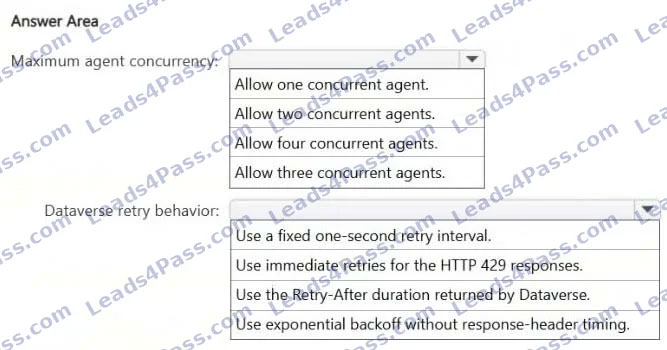
You have a Microsoft Foundry project that includes four independent analysis agents. Each agent invocation consumes 500 tokens per minute (TPM) from a Foundry deployment that has a TPM rate limit of 1,000.
After each agent completes, it writes 200 small records to Microsoft Dataverse. Running multiple agents simultaneously causes write bursts that result in HTTP 429 (Too Many Requests) responses.
You need to reduce the end-to-end task duration, while preventing provider and platform throttling. The solution must meet the following requirements:
– Keep as much agent parallelism as the TPM rate limit permits.
– Handle Dataverse throttling without sending premature retries.
How should you configure the orchestration? To answer, select the appropriate options in the answer area.
NOTE: Each correct selection is worth one point.
Question 2
Single choice
A multi-agent application stores conversation memory for many users. The memory must remain available across sessions, prevent one user from accessing another user’s data, and delete expired records automatically. Which design best meets these requirements?
A.Store memory in a persistent data store, partition it by user and session, enforce identity-based access controls, encrypt it, and apply retention policies with expiration times.Correct answer
B.Store all memory in a shared in-memory collection and clear it whenever any user ends a session.
C.Include the complete memory of every user in each agent’s system prompt.
D.Store memory indefinitely in local files and rely on agents to ignore records belonging to other users.
Question 3
Single choice
Note: This question is part of a series of questions that present the same scenario. Each question in the series contains a unique solution that might meet the stated goals. Some question sets might have more than one correct solution, while others might not have a correct solution.
After you answer a question in this section, you will NOT be able to return to it. As a result, these questions will not appear in the review screen.
You have a Microsoft Foundry Agent Service solution that includes two agents. You need to configure memory for the agents. The solution must meet the following requirements:
– Isolate the memory between end users.
– Isolate the memory between the agent domains.
– Support the deletion of one user’s memory without deleting other users’ memory.
Solution: You create one memory store per end user and configure both agents to use each user’s memory store with a static scope value.
Does this meet the goal?
A.Yes
B.No
Question 4
Single choice
You have a Microsoft Foundry project that contains an incident triage agent.
You have a Model Context Protocol (MCP) server registered in the organizational tool catalog. The MCP server exposes two tools named docs_search and deployment_delete.
You need to ensure that the agent can only invoke docs_search.
What should you configure?
A.the project details
B.the agent run configuration
C.the agent tool configuration
D.the agent instructions
Question 5
Drag and drop
DRAG DROP
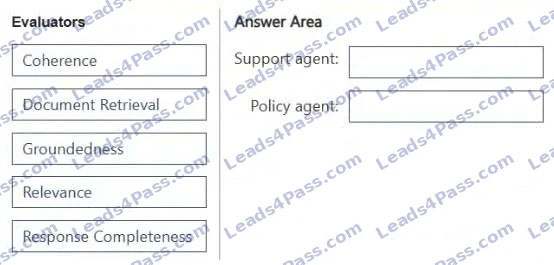
You have a multi-agent Retrieval-Augmented Generation (RAG) solution that uses a Foundry IQ knowledge base. The solution includes a support agent and a policy agent.
You have an evaluation dataset that contains the following for each user query:
– The expected source IDs.
– Retrieved chunks in rank order.
– The final agent response.
You discover that an embedding model change and a custom analyzer change cause the failed traces shown in the following table.

You need to isolate the failing parts of the RAG pipeline.
Which evaluator should you use for each agent? To answer, drag the appropriate evaluators to the correct agents. Each evaluator may be used once, more than once, or not at all. You may need to drag the split bar between panes or scroll to view content.
NOTE: Each correct selection is worth one point.
Question 6
Drag and drop
DRAG DROP
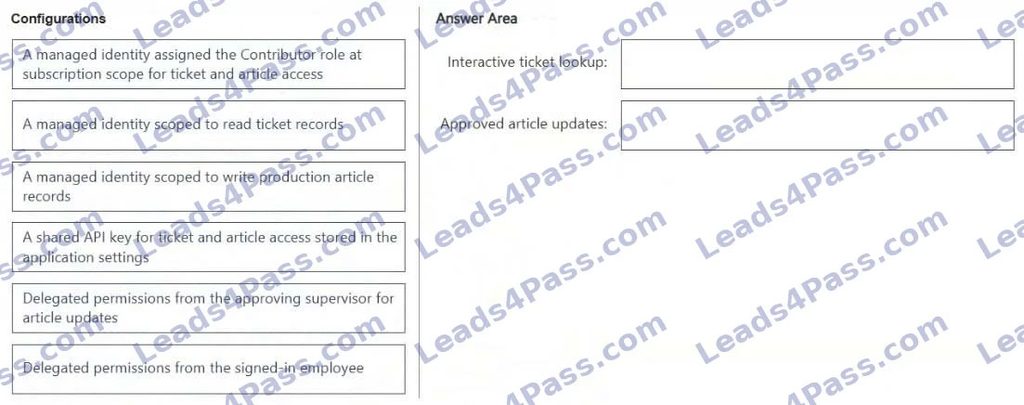
You have a Microsoft Foundry helpdesk triage agent. Employees sign in to the agent by using Microsoft Entra. The agent can invoke the following tools:
– A ticket search tool that enforces the existing per-employee authorization model – A knowledge article tool that writes to a separate production article repository.
You need to recommend an identity-based access configuration for the following execution contexts:
– Ensure that interactive ticket searches enforce per-employee authorization.
– Constrain approved article updates to the production article repository.
The solution must meet the following requirements:
– Prevent the use of embedded secrets.
– Follow the principle of least privilege.
Which access configurations should you recommend? To answer, drag the appropriate configurations to the correct execution contexts. Each configuration may be used once, more than once, or not at all. You may need to drag the split bar between panes or scroll to view content.
NOTE: Each correct selection is worth one point.
Question 7
Single choice
You have a Microsoft Foundry multi-agent solution that includes a main intake agent and a claims subagent.
Users sign in to a web app by using Microsoft Entra. The app calls the main intake agent API. Both agents have Microsoft Entra agent identities created from agent identity blueprints.
You plan to extend the solution to ensure that the main intake agent calls the claims subagent, and then the claims subagent calls Microsoft Graph and a custom claims API. The APIs authorize requests by using delegated scopes and do NOT accept application permissions.
You need to design the authentication flow. The solution must meet the following requirements:
– Preserve the signed-in user’s identity and delegated permissions across the full call chain.
– Distinguish agent operations from workforce user operations in audit logs.
– Prevent individual agent identities from storing credentials.
You decide to use an authorization code for the web app to call the main intake agent API.
What else should you include in the design?
A.Use client credentials with the agent identity blueprints to request application-permission tokens.
B.Use the agent user account OAuth flow with the agent users as the token subjects.
C.Use on-behalf-of (OBO) token exchanges with the applicable agent identities to request delegated tokens.
D.Require the interactive authorization code flow with user interaction.
Question 8
Drag and drop
DRAG DROP
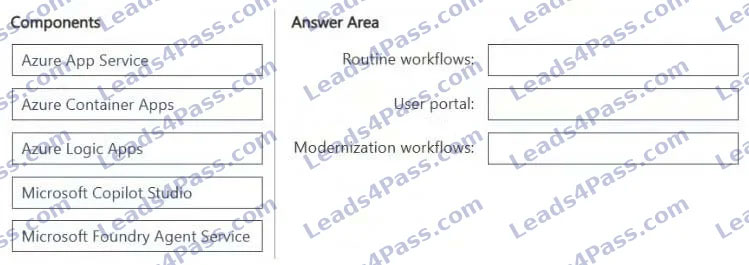
You are designing an enterprise automation solution that has a web portal for users and the following types of workflows:
– Routine workflows that use prompt-defined agents, approved knowledge stores, and HTTPS tools – Modernization workflows that use custom Microsoft Agent Framework code packaged as container images with predefined handoffs and task states.
You need to recommend Azure services that meets the following requirements:
– The routine workflows must run agents in a fully managed environment.
– The user portal must be deployed as a managed platform as a service (PaaS) web app.
– The modernization workflows must run agents in serverless containers that support automatic scaling.
What should you recommend for each requirement? To answer, drag the appropriate services to the correct components. Each service may be used once, more than once, or not at all. You may need to drag the split bar between panes or scroll to view content.
NOTE: Each correct selection is worth one point.
Question 9
Single choice
Note: This question is part of a series of questions that present the same scenario. Each question in the series contains a unique solution that might meet the stated goals. Some question sets might have more than one correct solution, while others might not have a correct solution.
After you answer a question in this section, you will NOT be able to return to it. As a result, these questions will not appear in the review screen.
You have a Microsoft Foundry Agent Service solution that includes two agents.
You need to configure memory for the agents. The solution must meet the following requirements:
– Isolate the memory between end users.
– Isolate the memory between the agent domains.
– Support the deletion of one user’s memory without deleting other users’ memory.
Solution: You create a dedicated memory store for each agent and set scope for each memory search tool to {{$userId}}.
Does this meet the goal?
A.Yes
B.No
Question 10
Single choice
You have a Microsoft Foundry multi-agent solution.
A developer publishes a new version of a specialist agent. Once the agent goes live in production, the solution starts mishandling requests.
You need to restore the previous behavior as quickly as possible.
What is the fastest way to roll back the agent?
A.Change the endpoint.
B.Create a new agent.
C.Redeploy the agent.
D.Delete the published version.
Question 11
Single choice
You have a Microsoft Foundry project for a multi-agent coding solution. The project includes agents that call GitHub tools. The tools return issue numbers, pull request numbers, branch names, commit SHAs, and workflow run links. Handoff payloads store copied acceptance criteria, check results, and repository names.
After long sessions, the review agent comments about outdated pull requests or attributes that failed workflow runs to the wrong branch. Trace logs show truncated tool output and stale check results in memory.
You need to improve entity continuity across agent transitions and reduce context window pressure.
What should you do?
A.Persist GitHub artifact identifiers in memory and handoffs. Rehydrate state from GitHub on each transition.
B.Persist the complete tool output in memory and handoffs. Inject the output before each invocation.
C.Persist a conversation-scoped thread across all the agents. Transfer the full transcript during each handoff.
D.Persist separate copied summaries for each agent. Reconcile the summaries during the review transition.
Question 12
Single choice
You have a Microsoft Foundry multi-agent customer support solution that retrieves grounding data from a shared vector index. The indexed corpus contains product runbooks in Markdown and support articles in HTML Both document types use a consistent hierarchical markup.
You discover that current fixed-size token chunking creates chunks that cross section boundaries.
You need to recommend a chunking approach for the ingestion pipeline. The solution must preserve existing document structure boundaries and minimize custom chunking code.
What should you recommend?
A.semantic chunking with topic-shift detection
B.format-specific chunking with header splitters
C.recursive character chunking with structure-aware separators
D.fixed-size chunking with token overlap
Question 13
Single choice
Retrieved text is inserted at runtime and may contain instructions such as “ignore the approval policy.” Prompt changes must also be promoted and reversible. Which implementation is appropriate?
A.Let examples override policy when retrieved text resembles an approved historical response.
B.Insert retrieval as developer instructions, then save each production edit as a new prompt version.
C.Keep policy at higher priority, mark retrieval as untrusted data, and version and evaluate prompts.
D.Concatenate all text at one priority and rely on source filtering instead of prompt regression tests.
Question 14
HOTSPOT
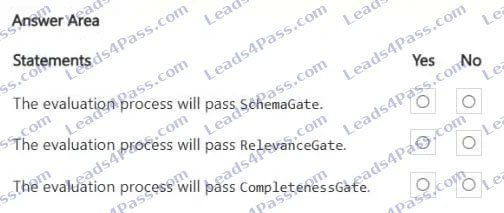
You have a Microsoft Foundry multi-agent solution. The agents contain the CI/CD evaluation gates shown in the following table.
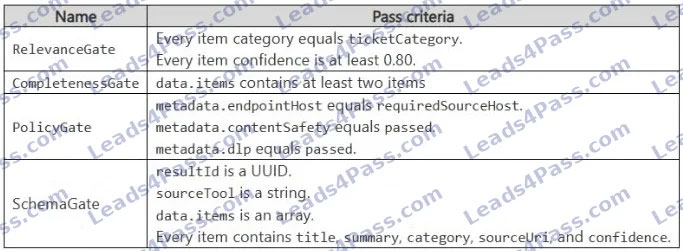
You call one of the agents by using the request context in the evaluation process as shown in the following table.

The agent receives the following results for the tool.
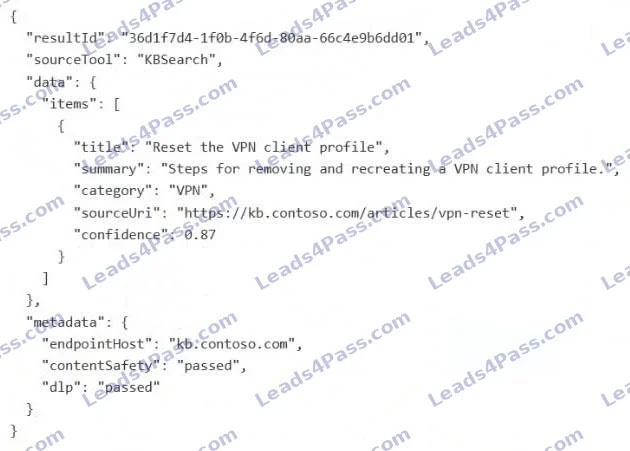
For each of the following statements, select Yes if the statement is true. Otherwise, select No.
NOTE: Each correct selection is worth one point.
Question 16
Single choice
You have an Azure AI Search service that supports knowledge retrieval for a multi-agent solution.
During the past 12 months, query volume steadily increased. Some search requests are now being throttled.
You need to reduce the likelihood that search requests are throttled.
Solution: You migrate to a higher service tier that provides greater query capacity and configure additional replicas.
Does this meet the goal?
A.Yes
B.No
If you want to explore further and verify the actual answers, please follow the prompts to obtain the complete AI-500 study materials.
When AI-200 Knowledge Helps
AI-200 is another related certification, but I would only bring it into your AI-500 preparation when the question involves Azure infrastructure.
AI-200 covers areas such as containers, Azure data services, service integration, security, monitoring, and troubleshooting.
Those skills can become useful when AI-500 questions move beyond the agent itself and into the environment supporting it.
For example, if a scenario involves storage, networking, compute, monitoring, or Azure service integration, your AI-200 knowledge may give you an advantage.
But I would not study AI-200 simply because it appears next to AI-500 on a certification list.
The overlap is practical, not absolute.
That’s an important difference.
A Simple AI-500 Study Routine
You don’t need a complicated preparation system.
A simple routine works well:
Study the topic → answer questions → review mistakes → return to the weak topic → answer similar questions again.
The mistake is moving directly from question to question without analyzing the mistakes.
Suppose you miss five questions about agent orchestration.
Don’t just memorize those five answers.
Ask why you missed them.
Maybe you don’t understand when parallel execution makes sense.
Maybe you are confusing orchestration with agent communication.
Maybe you know the concepts individually but have trouble identifying them in a scenario.
That tells you what to study next.
Practice questions should expose weaknesses.
They shouldn’t simply make you feel good because your score is increasing.
How Leads4Pass Can Fit Into Your AI-500 Preparation
Once you have reviewed the exam objectives and built a basic understanding of the technologies, practice becomes much more useful.
This is where an AI-500 question bank can help.
The Leads4Pass AI-500 preparation page provides AI-500 practice materials that can be used for question review and exam-oriented practice.
I would use it as a practice layer, not as a replacement for understanding the technology.
A good routine is straightforward:
- Study the topic.
- Work through AI-500 questions.
- Mark questions you cannot explain.
- Review the underlying concept.
- Return to the question later.
- Repeat until you can explain the answer without memorizing the wording.
Leads4Pass also offers different study formats across its certification materials, including PDF and Web TestEngine options, which can be useful depending on whether you prefer reading or interactive practice. Its current AI-103 preparation page, for example, separates those two formats and provides sample questions before purchase.
The same principle applies here: use practice to find what you don’t know.
Don’t use practice questions as a substitute for learning.
What Should You Know Before the Exam?
Before booking AI-500, I would want to be comfortable with five areas.
Architecture: You can look at a requirement and explain how agents, tools, memory, workflows, and human intervention should fit together.
Development: You can work with the major Azure and agent-development components rather than only recognize their names.
Evaluation: You understand how to measure quality, troubleshoot behavior, and identify regressions.
Security: You understand identities, permissions, authentication, secrets, tool access, and guardrails.
Deployment: You understand what changes when an AI system moves from development into a controlled production environment.
If one of these areas feels significantly weaker than the others, don’t hide that weakness by doing more random questions.
Study the weak area.
Then return to practice.
A Final Check Before You Take AI-500
The easiest way to judge readiness is not your number of completed practice questions.
Ask yourself whether you can explain the reasoning behind your answers.
If you see a question about multi-agent architecture, can you explain why one architecture is preferable?
If you see a memory question, can you identify what information actually needs to persist?
If you see a security question, can you identify who should have access to what?
If you see an evaluation question, can you explain how you would know whether the system is getting worse?
If you can do that without relying on memorized wording, you’re in a much better position.
AI-500 is still a relatively new Microsoft exam, and its current practice assessment is not yet available from Microsoft. That makes disciplined preparation even more important.
Don’t try to know everything.
Know the major concepts, understand how they connect, practice realistic scenarios, and pay close attention to the exact requirement in each question.
That’s a much more practical way to prepare for AI-500.
Author


Related Posts
AZ-802 Isn’t Just AZ-800 + AZ-801
How Do You Know You’re Ready for AZ-104? What Your Practice Score Doesn’t Tell You