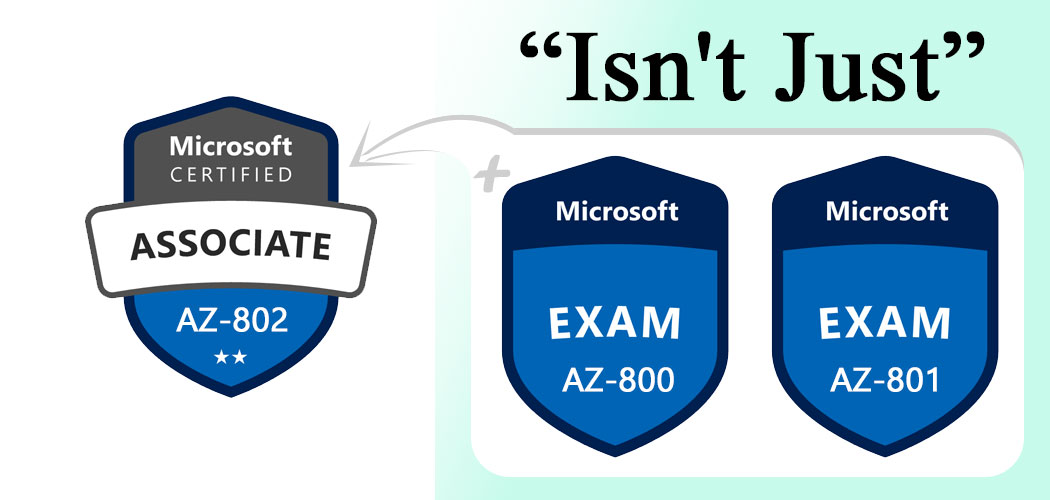
AZ-802 Isn’t Just AZ-800 + AZ-801
AZ-802 replaces the two-exam AZ-800/AZ-801 route, but preparing for it as if Microsoft simply combined two old exams misses the real change. The new blueprint reorganizes Windows Server administration around one broader role: managing identity, infrastructure, security, workloads, and troubleshooting across on-premises, cloud, and hybrid environments. If you already studied AZ-800 or AZ-801, that distinction matters.
What Actually Changed With AZ-802?
One exam replaces a two-exam route
The transition is straightforward on paper. AZ-800: Administering Windows Server Hybrid Core Infrastructure and AZ-801: Configuring Windows Server Hybrid Advanced Services are scheduled to retire on September 30, 2026. Microsoft’s new Windows Server Administrator Associate certification page says that once those exams retire, AZ-802 will remain as the available path to earn the certification.
That makes AZ-802 more than a new exam number. The old route separated Windows Server administration into two examinations. AZ-800 concentrated heavily on identity, hybrid management, virtualization, networking, and storage, while AZ-801 covered security, high availability, disaster recovery, migration, and monitoring. AZ-802 brings the relevant parts into one seven-domain blueprint.
The difference matters if you’re halfway through old study material. You don’t need to throw everything away, but you also shouldn’t assume that finishing an AZ-800 guide and then adding an AZ-801 guide gives you an accurate AZ-802 preparation plan.
The administrator role is being tested as a connected job
Look at the way Microsoft describes AZ-802. The exam is not limited to an on-premises Windows Server environment or a separate list of Azure services. It expects administrators to deploy, manage, and troubleshoot Windows Server workloads across on-premises, cloud, and hybrid environments.
That changes the way the knowledge fits together. AD DS can affect authentication. Authentication can affect access to file services. DNS can affect domain connectivity. Networking can affect Azure Arc management. A configuration problem can surface through monitoring rather than through the service where the original mistake occurred.
This is normal Windows Server administration in the real world. The server doesn’t care which chapter of a study guide a problem belongs to. AZ-802’s structure reflects that reality more closely than treating every technology as an independent subject.
The blueprint changed along with the emphasis
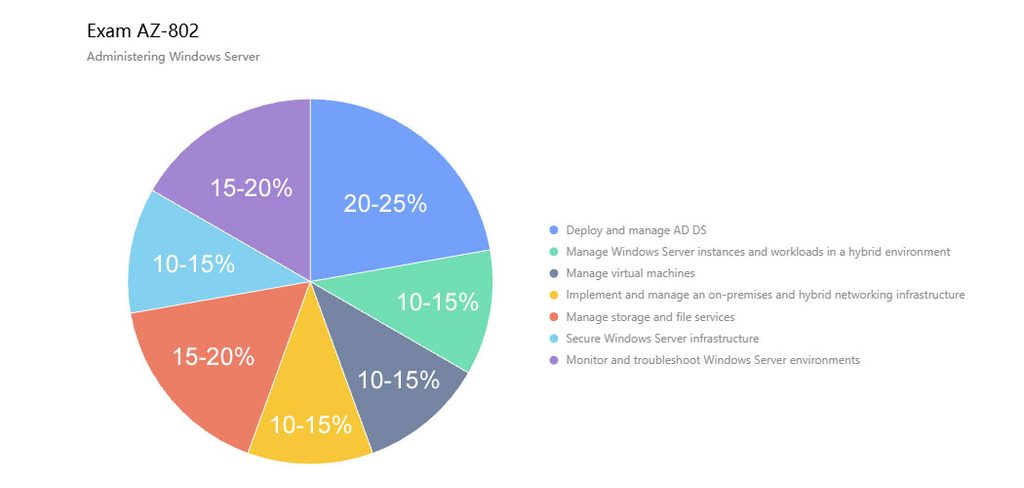
The current AZ-802 blueprint contains seven domains: AD DS at 20–25%, hybrid Windows Server management at 10–15%, virtual machines at 10–15%, hybrid networking at 10–15%, storage and file services at 15–20%, security at 10–15%, and monitoring and troubleshooting at 15–20%.
That distribution is revealing. Microsoft has not simply carried the old five-domain AZ-800 structure forward and attached the AZ-801 objectives underneath it. Security and monitoring are now explicit AZ-802 domains, while several areas that were prominent in AZ-801 are no longer standalone domains.
The result is a blueprint that is narrower in some places and broader in how the remaining technologies interact. That’s why an AZ-802 study guide should be treated as the current source of truth, even when an older AZ-800 or AZ-801 resource explains a technology very well.
AZ-802 Is Not a Simple AZ-800 + AZ-801 Merge
Combining domains does not mean preserving every old objective
The easiest mistake is to interpret the transition as arithmetic: AZ-800 plus AZ-801 equals AZ-802.
It doesn’t.
The old AZ-800 blueprint included virtualization and containers together, while AZ-802 now has a dedicated Manage virtual machines domain. The current blueprint also does not reproduce AZ-801’s former standalone domains for high availability, disaster recovery, and workload migration.
That doesn’t mean every related technology disappeared. High availability still appears in the Hyper-V objectives. Hyper-V Replica remains in the virtual-machine section. Storage Replica remains under storage, and migration-related tasks still exist around Azure Files and Azure File Sync.
The distinction is important. A topic can survive without retaining the same role or weight it had in an older exam. If you are comparing AZ-800 vs AZ-802 or AZ-801 vs AZ-802, compare the actual current objectives rather than assuming that a familiar technology has the same exam importance.
The new blueprint changes how the topics connect
A good example is troubleshooting. In an older preparation plan, you might study DNS, AD DS, storage, virtualization, and networking as separate chapters and feel comfortable once you can answer questions about each one.
AZ-802 gives you more reason to connect those subjects.
A Windows Server problem rarely announces itself with a label saying “this is an AD DS question.” A domain controller problem may involve DNS. A connectivity problem may involve firewall configuration, name resolution, or IP addressing. An Azure Arc issue may involve the server, connectivity, extensions, or management configuration. Microsoft explicitly includes troubleshooting across connectivity, name resolution, Windows Update, time service, performance, VM and Azure Arc extensions, storage, encryption, and Active Directory.
That makes diagnostic thinking more useful than memorizing isolated definitions.
What From AZ-800 and AZ-801 Still Matters?
The Windows Server foundation is still the foundation
If you spent weeks studying AD DS, DNS, DHCP, Hyper-V, PowerShell, storage, networking, and Windows Server administration for AZ-800, that work is not suddenly worthless.
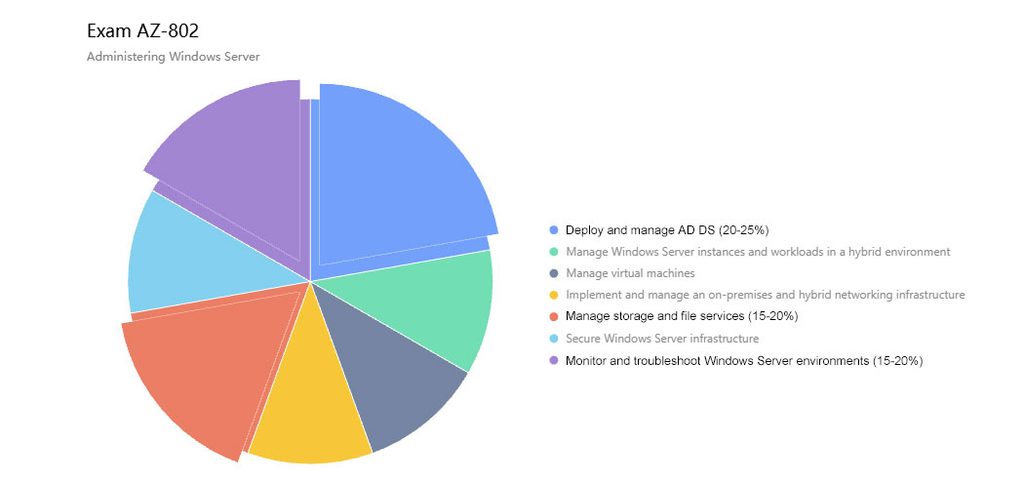
Quite the opposite. The current AZ-802 objectives still depend heavily on those fundamentals. AD DS is the largest individual domain at 20–25%. Storage and file services account for 15–20%, while monitoring and troubleshooting also account for 15–20%. Hybrid management, virtualization, networking, and security each remain part of the exam.
The useful parts of older material are therefore the parts that teach you how Windows Server actually works. Understanding domain controllers is useful. Understanding replication is useful. Knowing how DNS interacts with AD DS is useful. Being comfortable with PowerShell and Hyper-V is useful.
What changes is the context around that knowledge.
Old knowledge needs to be viewed through the AZ-802 blueprint
The better question isn’t “Is AZ-800 material still valid?”
Ask: “Does this material teach something that appears in the current AZ-802 skills measured?”
If yes, keep it.
Then check whether the old explanation reflects the current technologies and current objective wording. This is particularly important around hybrid management and security. Microsoft now explicitly includes Azure Arc, Azure Update Manager, Azure Monitor, OSConfig security baselines, Microsoft Entra Password Protection, and newer management scenarios.
For someone coming from AZ-800, this means the efficient route is usually selective updating rather than starting from page one. For someone coming from AZ-801, the same principle applies, but the gap can be different: some advanced topics you studied may no longer deserve the same amount of time, while core Windows Server administration may deserve more attention than your old plan gave it.
If you already have substantial AZ-800/AZ-801 material, use it as a knowledge base, not as the AZ-802 blueprint.
What Is New or More Important in AZ-802?
Hybrid management is no longer a side topic
Azure Arc is one of the clearest signals in the new exam. Microsoft expects candidates to understand how Windows Server instances outside Azure can be connected to Azure management capabilities, including configuration and VM extensions.
Azure Update Manager and Azure Automation also appear in the hybrid management objectives. Windows Admin Center, PowerShell remoting, SSH, and remote desktop remain part of the administrator toolkit.
This doesn’t mean AZ-802 has suddenly become an Azure administration exam. Windows Server remains at the center. The difference is that the administrator is expected to manage that server without pretending the data center and cloud are separate worlds.
That is why simply memorizing Azure Arc terminology is unlikely to be enough. You want to understand what problem Arc solves, what happens when a server is connected, how management actions are applied, and what you would investigate when that relationship stops working.
Security, monitoring, and newer administration tools change the picture
The security domain contains several technologies that deserve attention because they show where the current Windows Server role is heading. Microsoft includes OSConfig for security baselines, Windows Local Administrator Password Solution, Defender for Servers, Credential Guard, application control, Windows Firewall, and Microsoft Entra Password Protection for AD DS.
The monitoring side has a similar pattern. AZ-802 includes traditional Windows Server tools such as Performance Monitor and event logs alongside Azure Monitor, VM Insights, alerts, and data collection rules.
Then there are details such as SMB over QUIC and GPU partitioning. These aren’t reasons to memorize a list of new acronyms. They are signals that the current exam expects familiarity with newer Windows Server capabilities alongside the established administration stack.
The best way to approach these topics is to ask what operational problem each technology addresses. That gives the knowledge somewhere to attach instead of leaving you with another collection of isolated facts.
Where Should You Spend Your Study Time?
Read the percentages as signals, not isolated study blocks
The AZ-802 percentages are useful, but they should not become a rigid timetable.
AD DS has the highest published weight at 20–25%, so it deserves serious attention. Storage and file services and monitoring and troubleshooting each sit at 15–20%. The remaining domains range from 10–15%.
But a troubleshooting scenario can involve AD DS, DNS, networking, security, and monitoring at the same time. A hybrid management problem can involve PowerShell, Azure Arc, connectivity, identity, and configuration.
So study weight does not equal an isolated study block.
If you spend two days memorizing AD DS commands but cannot explain why DNS affects domain authentication, the percentage didn’t help much. Likewise, knowing what Azure Arc is doesn’t help if you cannot reason through a failed connection or extension problem.
Use the percentages to decide where to spend more time, then use connected scenarios to test whether the knowledge actually works together.
Build cross-domain troubleshooting ability
This is where hands-on work becomes especially valuable.
Build a small Windows Server lab if your environment allows it. Create a domain. Work with DNS. Join machines. Configure policies. Test storage and file access. Use Hyper-V. Experiment with PowerShell. Then deliberately break things and troubleshoot them.
The point isn’t to reproduce every possible exam environment. It is to build the mental habit of asking, “What changed, where would I observe it, and which dependency could explain it?”
Microsoft itself recommends hands-on experience for AZ-802. Recent candidates have also described the exam as broad and scenario-heavy, with long question contexts and meaningful time pressure. Those reports are individual experiences, not Microsoft statistics, but they point toward a preparation method that rewards understanding over simple recognition.
If you want to check readiness with additional AZ-802 preparation materials (https://www.leads4pass.com/az-802.html), the useful test is whether the questions force you to reason through a situation rather than merely recognize a definition.
What Recent AZ-802 Exam Experiences Tell Us
Candidate reports point to breadth, context, and time management
Recent AZ-802 beta testers on the Azure Certification community described questions with lengthy scenarios, broad coverage across Windows Server technologies, and difficulty managing time while using Microsoft Learn. One candidate reported using AZ-800/AZ-801 material alongside the AZ-802 study guide, while another described hands-on VM work as particularly useful.
Those experiences should be treated carefully. They do not establish an official question format, average difficulty, pass rate, or typical score. They are snapshots from individual candidates taking the exam during its transition.
Still, there is a useful pattern in the reports: people who expected a narrow exam found themselves moving between different technical areas. That fits the published blueprint reasonably well. AZ-802 covers identity, hybrid management, virtualization, networking, storage, security, and monitoring in one sitting.
That breadth changes how you should practice. Don’t spend every practice session inside one technology. Give yourself scenarios where the problem moves from one layer to another. Also practice reading the question carefully without spending several minutes trying to reconstruct every detail in your head. The ability to identify the relevant facts quickly is a real part of exam preparation when the context is dense.
Conclusion
AZ-802 is easier to understand once you stop treating it as a box containing AZ-800 and AZ-801.
The transition is really about how Windows Server administration is being packaged and tested. Microsoft has moved from two separate exam experiences to one current blueprint covering identity, hybrid management, virtualization, networking, storage, security, and monitoring. Some old material remains highly useful. Some deserves a quick review. Some belongs to the old blueprint and should no longer control your study schedule.
If you already prepared for AZ-800 or AZ-801, don’t start over just because the exam number changed. Compare what you know against the current AZ-802 objectives, identify the gaps, add the newer hybrid and security technologies, and spend enough time troubleshooting connected scenarios to make the knowledge usable.
That is a much better preparation strategy than simply stacking two old study guides on top of each other.
FAQ: Can I use AZ-800 material for AZ-802?
Yes. Much of the Windows Server foundation from AZ-800 remains directly relevant, especially AD DS, hybrid management, virtualization, networking, storage, PowerShell, and core administration. The important part is to map that material against the current AZ-802 blueprint instead of assuming the old weighting and objectives still apply.
FAQ: Can I use AZ-801 material for AZ-802?
Yes, selectively. Security and monitoring are both explicit AZ-802 domains, so relevant AZ-801 material can still help. But AZ-802 does not simply preserve every AZ-801 objective, so areas such as high availability, disaster recovery, and migration should be checked against the current study guide rather than automatically carried into your preparation plan.
FAQ: Is AZ-802 harder because it combines two exams?
There is no reliable official statistic that supports a direct difficulty comparison. Recent candidate reports describe broad coverage, long scenarios, and time pressure, but those are individual experiences rather than an official measure of exam difficulty. The safer conclusion is that AZ-802 requires you to move across several Windows Server administration areas within one exam.
FAQ: What should I study first for AZ-802?
Start with the current Microsoft skills measured document, then make sure your Windows Server fundamentals are solid. AD DS deserves substantial attention because it carries the largest published weighting, followed by storage/file services and monitoring/troubleshooting. After that, connect networking, virtualization, security, and hybrid management instead of studying them as completely separate subjects.
FAQ: What should I know before scheduling AZ-802?
As of September 2026, Microsoft lists AZ-802 as a 120-minute proctored exam, with a passing score of 700 and a U.S. list price of $165. It is currently offered in English. Microsoft also states that AZ-800 and AZ-801 retire on September 30, 2026, and that AZ-802 will remain the available path for the Windows Server Administrator Associate certification after the transition.
Author