How Do You Know You’re Ready for AZ-104? What Your Practice Score Doesn’t Tell You
You finish the course. Your practice scores improve. You can explain most of the services in the blueprint. Yet booking the exam still feels like a decision rather than a formality.
That hesitation is worth paying attention to. AZ-104 readiness is better measured by what you can do with your knowledge than by how much preparation you have completed.
A Practice Score Can Tell You Something — Just Not Everything
A good practice score feels reassuring, and it should. If you are consistently performing well, you have probably built a useful level of knowledge.
But I would treat a practice score as a signal, not a verdict.
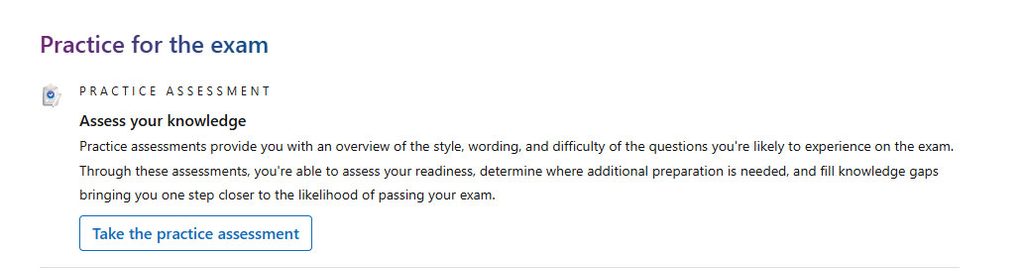
Microsoft’s own Practice Assessments are designed to help candidates identify knowledge gaps and assess readiness. They also provide explanations and references after questions are answered. That makes them useful.
The mistake is treating the number as the final answer.
Recent candidate experiences make this distinction particularly clear. Some AZ-104 candidates have reported scoring in the 80–90% range on practice exams and still failing the real exam. Others have passed after spending substantial time building Azure projects, working through labs, and deliberately reviewing why incorrect answers were wrong.
That does not mean practice tests are unreliable. It means they measure one part of preparation.
A practice question can tell you whether you selected the correct answer.
It does not necessarily tell you whether you could:
- configure the same service without a walkthrough;
- recognize why a deployment failed;
- choose between two technically valid approaches;
- troubleshoot an unfamiliar configuration;
- adapt when a requirement changes;
- explain why one Azure solution is preferable to another.
Those are different abilities.
The value of another practice test is therefore not simply another percentage. The more useful question is what the result revealed about your thinking.
If you want additional structured practice after using Microsoft’s assessment tools, AZ-104 practice materials can be used as another way to test your reasoning and identify areas that deserve review.
The important part is how you use the questions. If you only collect scores, you are measuring performance on tests. If you investigate every mistake, you are using those tests as a diagnostic tool.
That distinction matters much more as exam day approaches.
Read the AZ-104 Blueprint as an Ability Checklist
Many candidates study the AZ-104 objectives as a list of subjects.
Identity. Storage. Compute. Networking. Monitoring.
That is useful for organizing material, but it does not tell you whether you can actually perform the work.
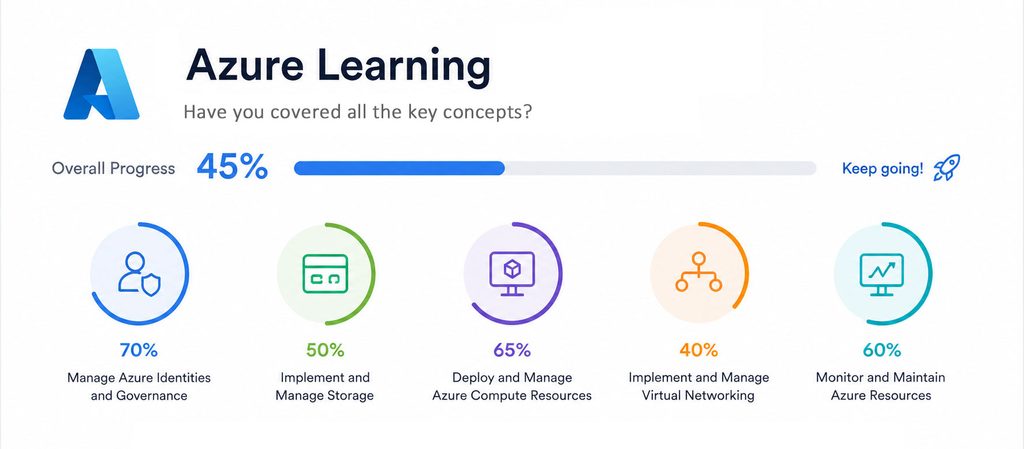
The current Microsoft AZ-104 study guide, updated in April 2026, still organizes the exam around five major skill areas. The more important detail is the language Microsoft uses to describe what candidates are expected to do.
The objectives repeatedly use verbs such as configure, deploy, manage, troubleshoot, evaluate, interpret, analyze, monitor, implement, and provision.
Those verbs change how you should evaluate yourself.
Suppose you have studied Azure virtual networking for several hours. You understand VNets, subnets, peering, NSGs, routing, and private connectivity.
That is topic familiarity.
Now imagine being given a scenario where:
- two networks need to communicate;
- traffic is not reaching the expected destination;
- an NSG rule is blocking part of the traffic;
- the requirement changes after the initial design;
- you need to determine which configuration should be changed.
Now you are being tested on application and troubleshooting.
The difference is easy to overlook because both candidates may describe the same Azure concepts correctly.
One can recognize the information.
The other can use it.
For AZ-104, your preparation should gradually move from “I know this topic” toward “I can do something with this knowledge.”
That is the standard I would use when reviewing the blueprint.
My Six-Part Readiness Check for AZ-104
This is not a Microsoft scoring system. It is a practical framework for judging whether your preparation has moved beyond memorization.
I would look for six types of evidence:
Explain → Apply → Troubleshoot → Adapt → Cover → Diagnose
You do not need to be perfect in every area. But if several of these are missing, a high practice score may be giving you more confidence than evidence.
1. Explain
Pick an AZ-104 topic without opening your notes.
Can you explain what the service or feature does, when you would use it, and what problem it solves?
More importantly, can you explain why you would choose it instead of another option?
For example, knowing what RBAC is is not the same as being able to explain why a particular role should be assigned at subscription, resource group, or resource scope.
If your explanation depends heavily on memorized definitions, keep working.
If you can explain the decision in your own words and connect it to a realistic administrative requirement, that is stronger evidence.
2. Apply
Next, remove the safety net.
Open the Azure portal, CLI, PowerShell, or another appropriate tool and perform the task without following a step-by-step tutorial.
Create something.
Configure something.
Change something.
Then verify the result.
This is where candidates sometimes discover that recognition was mistaken for understanding.
A tutorial makes the sequence visible. Real work requires you to decide what to do next.
You do not need to build an enormous Azure environment. A small lab that forces you to make the decisions yourself can reveal more than another hour of passive reading.
3. Troubleshoot
This is where preparation becomes much more interesting.
Take something that should work and deliberately create a problem.
A connection fails.
A user cannot access a resource.
A deployment does not produce the expected result.
A storage configuration does not behave as intended.
Now investigate.
Do not immediately search for the answer.
Ask yourself what evidence would distinguish one possible cause from another.
That habit is valuable because troubleshooting requires more than remembering a feature. You need to connect symptoms, configuration, permissions, networking, dependencies, and expected behavior.
A candidate who can only configure Azure when everything goes according to the tutorial has not yet demonstrated the same level of ability.
4. Adapt
This is the readiness check I would not skip.
Complete a lab successfully.
Then change one important requirement.
For example, change the access requirement, network relationship, scaling requirement, storage condition, or monitoring expectation.
Can you adjust your solution without starting the tutorial again?
This tests whether you understood the underlying decision or simply reproduced a sequence of clicks.
It also creates a useful bridge between practice questions and hands-on work.
A question gives you a scenario.
A lab gives you an environment.
An altered lab forces you to reason.
That combination is much closer to the type of thinking you want before the exam.
5. Cover
Your job experience can create a misleading sense of readiness.
If you work with virtual machines every day, compute may feel easy.
If your job revolves around identity, RBAC may feel familiar.
If you rarely touch containers, governance, storage configuration, or parts of networking, those areas can quietly become your weakest points.
I would divide the AZ-104 objectives into three groups:
Daily work: areas you use regularly.
Occasional work: areas you understand but do not frequently manage.
Rarely touched: areas where most of your knowledge comes from study rather than experience.
Spend disproportionate review time on the third group.
Experience gives you depth.
The exam also requires breadth.
Several recent candidates have described this exact problem: their professional Azure work covered only a portion of the exam’s surface area. Their experience was real, but it did not automatically translate into complete exam coverage.
That is why “I use Azure at work” is useful evidence—but it is not enough by itself.
6. Diagnose
Finally, look at your mistakes.
Not just your percentage.
Take a question you answered incorrectly and classify the reason.
Did you:
- not know the feature?
- confuse two similar services?
- misunderstand the requirement?
- overlook a constraint?
- choose a technically possible but inappropriate solution?
- misread the wording?
- know the concept but fail to apply it to the scenario?
Those are different problems.
If you repeatedly make the same type of mistake, you have found something much more valuable than a low score.
You have found a pattern.
And patterns are fixable.
Why Azure Experience Doesn’t Automatically Mean AZ-104 Readiness
There is a common trap for experienced IT professionals.
You work with Azure every day, so the exam should be straightforward.
Sometimes it is.
Sometimes it is not.
The reason is simple: production responsibility and exam coverage are not identical.
Your organization may have a dedicated networking team. Another person may manage Entra ID. Your infrastructure team may handle storage policies. Your own role may focus heavily on virtual machines and deployments.
The AZ-104 exam can still ask you to reason across those areas.
That does not make your professional experience less valuable. It simply means you should identify where your experience stops and deliberate preparation begins.
The same issue appears in reverse.
A candidate with limited professional Azure experience can sometimes build enough hands-on exposure through personal projects and labs to become surprisingly comfortable with the environment.
That is why I would not divide candidates into “experienced” and “inexperienced.”
I would ask a more useful question:
Which parts of the AZ-104 blueprint have you actually practiced?
Your answer may reveal more than the number of years on your résumé.
Should You Keep Studying or Book the Exam?
This is where many candidates get stuck.
They keep taking practice tests because they want a number that feels safe.
But there is no magic percentage that can guarantee readiness.
Instead, identify the type of problem you still have.
You have a knowledge problem if:
You cannot explain how a service works.
You repeatedly forget the same concept.
You cannot distinguish between similar Azure capabilities.
You do not understand why one answer is technically correct.
The solution is more learning.
Read the documentation. Review the objective. Build a small lab. Explain the concept in your own words.
You have a performance problem if:
You understand the concept but struggle to configure it.
You need a walkthrough every time.
You know what should happen but cannot identify why it did not happen.
You can answer straightforward questions but struggle when the scenario changes.
The solution is not necessarily another course.
You need more interaction with the environment.
This distinction can save a surprising amount of study time.
A candidate with a performance problem can spend another twenty hours reading and still feel uncomfortable when faced with an unfamiliar scenario.
Likewise, someone with a genuine knowledge gap will not solve the problem simply by doing more labs without understanding what they are configuring.
Find the problem before choosing the remedy.
Your Final Week Should Validate, Not Expand, Your Preparation
The final week is a poor time to discover another giant study resource.
At this point, I would switch from learning mode to validation mode.
Start by reviewing the current AZ-104 objectives without your notes. Mark the areas where your confidence comes from actual experience and the areas where it comes only from reading or watching content.
Then use a practice assessment or practice test.
Do not obsess over the final score.
Review the questions you missed and the questions you guessed correctly.
A guessed answer is not the same as demonstrated knowledge.
Next, perform several hands-on tasks without a tutorial.
Pick tasks from areas you do not use every day. If something goes wrong, give yourself time to investigate before looking for the solution.
Then revisit your weakest objective areas.
The day before the exam is not the time to build an entirely new knowledge base. Review key notes, confirm your exam logistics, and give your brain some space.
The goal of the final week is not to make preparation feel larger.
It is to make uncertainty smaller.
What I Would Want to See Before Booking AZ-104
Before booking the exam, I would want to see evidence of six things:
- Explain: You can describe Azure decisions without relying on memorized wording.
- Apply: You can perform common administrative tasks without a tutorial holding your hand.
- Troubleshoot: You can investigate an unexpected result instead of immediately looking for the answer.
- Adapt: You can modify a working solution when the requirement changes.
- Cover: You have deliberately checked the parts of the blueprint your job rarely exposes you to.
- Diagnose: You understand why your practice answers are wrong, rather than simply trying to increase the percentage.
If those six areas are reasonably strong, your practice score becomes much more meaningful.
If your score is high but several of those areas are weak, I would be more cautious about booking.
That does not mean you need months of additional preparation.
It means you should fix the specific weakness instead of collecting more evidence that you can answer familiar questions.
If you want another way to test that evidence before booking, structured AZ-104 practice resources can complement hands-on labs and Microsoft Learn. The useful role of practice is not to replace those activities. It is to expose weak reasoning and unfamiliar scenarios while you still have time to address them.
Readiness Is Something You Can Demonstrate
Study hours tell you how much time you invested.
A practice score tells you how you performed on a particular assessment.
Neither one, by itself, proves that you are ready for AZ-104.
A stronger test is whether your knowledge survives outside the exact material you studied.
Can you explain the decision?
Can you apply it?
Can you troubleshoot it?
Can you adapt when the requirement changes?
Have you covered the parts of the blueprint your job rarely touches?
And when you get a practice question wrong, do you understand the reason?
That is the difference between exposure, practice, and readiness.
Before you book AZ-104, don’t ask whether you’ve studied enough.
Ask whether you can prove that what you’ve studied still works when the question, requirement, or environment changes.
Author