
DP-100 Exam Is Ending in 2026 — What This Shift Really Means for Your AI Career
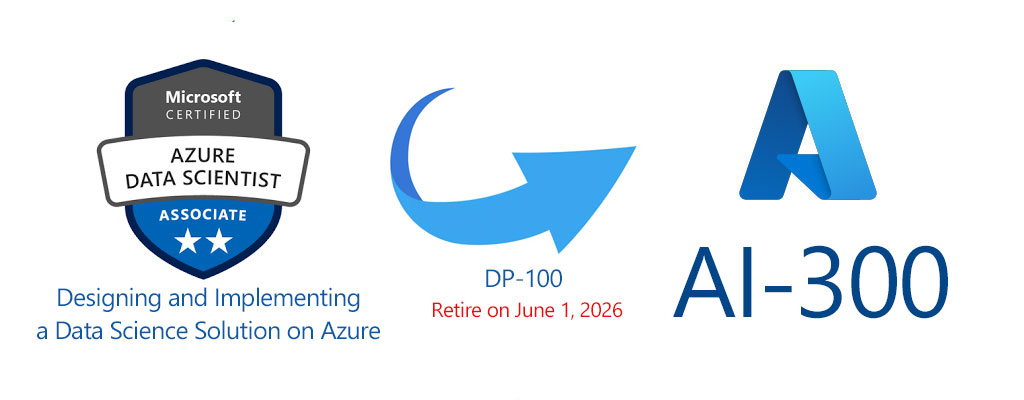
I began writing articles related to the DP-100 exam back in 2020, and four years have now passed.
Recent changes have necessitated a complete rewrite of this article; I will go into the details below…
The End of DP-100 Is Not Just a Retirement
The DP-100 exam (Azure Data Scientist Associate) is officially retiring on June 1, 2026, and it’s not being quietly phased out—it’s being replaced by a completely new certification: AI-300 (MLOps Engineer Associate).
That detail alone should raise eyebrows. Certifications don’t usually disappear unless the underlying role itself is evolving. And that’s exactly what’s happening here.
Microsoft isn’t just swapping exam codes. It’s redefining what it means to work in AI on Azure. The old model—build a model, evaluate it, deploy it once—is no longer enough. The new expectation revolves around continuous systems, automation, and AI operating in production environments at scale.
Why Microsoft Is Rewriting Its Certification Strategy
There’s a deeper signal behind this shift. Microsoft explicitly states that certifications are retired to keep pace with real-world job roles and technologies.
And right now, the industry is moving fast:
- Generative AI is no longer experimental
- AI systems are embedded into products
- Deployment pipelines matter more than model accuracy alone
The introduction of AI-300 reflects this reality. It validates skills like:
- CI/CD for machine learning
- Infrastructure as code
- Monitoring, observability, and governance
- Optimization of generative AI systems
These are not “nice-to-have” skills anymore—they define whether your model survives outside a notebook.
Why Most Candidates Misread This Change
The “I Just Got Certified” Problem
There’s a recurring frustration floating around in the community—people invest months preparing for DP-100, finally pass it, and then discover it’s already on its way out.
That reaction is understandable. But it also reveals something deeper: many candidates still treat certifications as static achievements, not snapshots of evolving skills.
The uncomfortable truth? Certifications in AI now have a shorter shelf life because the technology itself is moving faster than ever.
Outdated Study Paths and Misaligned Expectations
A lot of DP-100 preparation content still revolves around:
- Jupyter notebooks
- Basic model training workflows
- Simplified deployment steps
That approach worked in the past. It doesn’t reflect current expectations.
AI roles now demand:
- Integration with DevOps pipelines
- Automated retraining workflows
- Real-time monitoring and rollback strategies
Studying old materials creates a dangerous illusion—you feel prepared, but only for a version of the job that’s already fading.
What DP-100 Actually Tested vs What AI-300 Demands
Core Skill Differences
Model Building vs System Deployment
DP-100 was heavily focused on the data science lifecycle:
- Data preparation
- Feature engineering
- Model training and evaluation
AI-300 shifts the focus toward operationalizing AI systems. The model is no longer the end goal—it’s just one component in a larger pipeline.
Experimentation vs Production Engineering
The mindset has changed:
- DP-100: “Can you build a working model?”
- AI-300: “Can you run that model reliably in production?”
That difference is subtle but massive.
Side-by-Side Comparison Table
| Skill Area | DP-100 (Old) | AI-300 (New) |
|---|---|---|
| Focus | Model development | AI system lifecycle |
| Deployment | Basic endpoints | Full CI/CD pipelines |
| Infrastructure | Minimal setup | IaC, automation tools |
| Monitoring | Basic evaluation | Drift detection, observability |
| AI Scope | Traditional ML | ML + Generative AI |
| Responsibility | Data scientist | MLOps engineer |
Microsoft explicitly expanded the scope to include automation, governance, and generative AI optimization, signaling a broader role definition.
The Hidden Reason Candidates Struggle
Notebook Comfort vs Production Reality
Most candidates are comfortable inside notebooks. Everything is controlled, reproducible, and relatively clean.
Production environments are the opposite:
- Data changes unpredictably
- Models degrade over time
- Failures happen at scale
The gap between these two environments is where most candidates fail—not because they lack intelligence, but because they lack exposure.
Missing MLOps and Infrastructure Skills
Here’s what’s often missing:
- Versioning models and datasets
- Automating pipelines
- Managing deployments across environments
- Monitoring model performance in real time
These aren’t advanced topics anymore. They’re baseline expectations.
AI-300 formalizes this shift by testing end-to-end lifecycle management, not just isolated tasks.
Smarter Preparation Strategy for 2026
Learning Paths That Actually Work
Microsoft Learn + Labs
Start with official learning paths, but don’t stop there. Reading documentation without hands-on work creates a false sense of progress.
The real learning happens when you:
- Build pipelines
- Break deployments
- Fix them under pressure
That’s where understanding sticks.
Practice Exams and Real Scenarios
Practice tests still have value—but only when used correctly.
Instead of memorizing answers, use them to:
- Identify weak areas
- Simulate time pressure
- Understand question patterns
A balanced preparation approach might include resources like
https://www.leads4pass.com/dp-100.html
alongside official materials and hands-on labs.
The key is diversity. No single resource is enough anymore.
Certification Path in the AI Era
From Fundamentals to MLOps Engineer
A modern certification journey now looks more like this:
- Fundamentals → AI basics, cloud concepts
- Associate (Old) → Data science foundations (DP-100)
- Associate (New) → AI systems & MLOps (AI-300)
This progression mirrors the industry shift—from understanding AI to operationalizing it at scale.
Positioning Yourself for AI Roles
The most valuable candidates today aren’t just model builders. They are:
- System thinkers
- Engineers who understand lifecycle management
- Professionals who can bridge data science and DevOps
That’s exactly what AI-300 is designed to validate.
Should You Still Take DP-100 in 2026?
When It Still Makes Sense
There are still scenarios where DP-100 is worth pursuing:
- You’re close to exam readiness
- You need foundational knowledge quickly
- Your role is still heavily focused on experimentation
In those cases, finishing what you started can still provide value.
When You Should Pivot Immediately
Pivoting to AI-300 is the smarter move when:
- You’re just starting preparation
- You want long-term relevance
- You’re targeting production-level AI roles
Because here’s the reality: the industry has already moved forward. The certification is simply catching up.
Conclusion
The retirement of the DP-100 exam isn’t a minor update—it’s a signal.
The role of a “data scientist” in the cloud ecosystem is being redefined into something more operational, more engineering-driven, and more aligned with real-world AI systems. AI-300 doesn’t just replace DP-100—it raises the bar.
Ignoring this shift leads to wasted effort. Understanding it creates leverage.
The real question isn’t whether DP-100 is still valuable. It’s whether your skill set matches where the industry is going next.
FAQs
1. Is the DP-100 exam still worth taking before June 2026?
Yes, but only if you are already well-prepared or need immediate certification. Otherwise, AI-300 offers better long-term value.
2. What is the main difference between DP-100 and AI-300?
DP-100 focuses on model building, while AI-300 emphasizes deployment, automation, and lifecycle management of AI systems.
3. Does AI-300 include generative AI topics?
Yes. It includes operationalizing generative AI systems, including optimization and monitoring.
4. Will my DP-100 certification still be valid after retirement?
Yes. Certifications remain on your transcript until they expire, even after retirement.
5. What skills should I prioritize for AI-300?
Focus on:
- MLOps pipelines
- CI/CD automation
- Azure ML deployment
- Monitoring and governance
Author